Headquarters
EnergyCAP, LLC
360 Discovery Drive
Boalsburg, PA 16827
Denver, CO
Suite 500
5445 DTC Parkway
Greenwood Village, CO 80111
Dublin, Ireland
Unit F, The Digital Court, Rainsford Street,
Dublin 8, D08 R2YP, Ireland
Phone: 877.327.3702
Fax: 719.623.0577
EnergyCAP® offers energy managers a sobering question worth asking: how much did your team find out about last month’s cost spike? And when did you find out?
For most teams, the answer is: from the invoice. And sometime in the next billing cycle.
That gap between the moment a cost problem starts and the moment someone on your team knows about it isn’t a gap in effort. It’s a gap built into the workflow itself.
Energy managers are not sitting still. They’re managing more sites, more commodities, and more reporting obligations than they were five years ago. The complexity of the portfolio has grown; the size of the team has not.
Most of the work still runs through manual processes: pulling bills, building spreadsheets, and running reports. Analysis takes time. A cross-site anomaly comparison that should take 10 minutes takes three hours. A question from the CFO on a Tuesday afternoon might not have a clean answer until Thursday.
By then, the window to act has often closed.
This is not a discipline problem. It is a structural one. When the time required to get an answer exceeds the time available to act on it, teams adapt the only way they can: they ask fewer questions.
The cost of delayed insight is not always visible on a single invoice. It accumulates.
Consider three scenarios energy and finance teams recognize immediately:
In each scenario, the cost is not just the direct dollar impact. It is the compounding effect of operating without current information and losing the opportunity to recover costs or improve efficiency.
Here’s the behavioral shift that tends to go unnoticed: when getting an answer is hard enough, teams stop asking.
An energy manager who knows that pulling a cross-site comparison takes three hours will, over time, pull it less often. Not because it isn’t valuable but because the ROI on that time investment doesn’t always pencil out in a week where five other things are also urgent.
The same is true at the finance and leadership level. If a controller asks what drove last quarter’s utility variance and the answer takes two days to produce, they start treating utility costs as a black box.
Insight latency creates decision avoidance. And decision avoidance is where money quietly disappears.
Teams that have closed the gap between question and answer don’t necessarily have more staff. They have faster access to their own data.
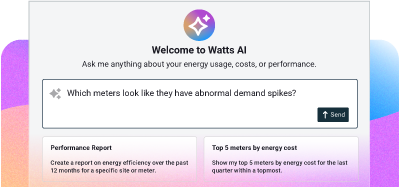
Picture this: a facilities director notices a spike in a monthly cost summary and wonders if it’s isolated to one building or showing up across the portfolio. Instead of sending that question to the energy manager and waiting for a report, they ask it directly: “Show me sites with above-average electricity cost per square foot this month.” They have an answer in seconds, drawn from validated utility data they’ve already trusted for billing and compliance.
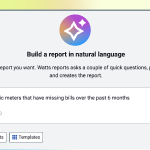
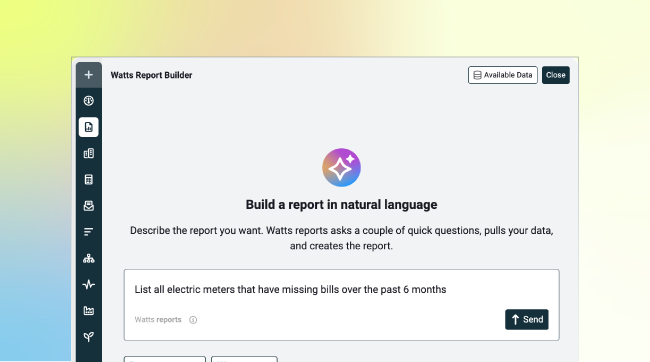
That’s what Chat powered by EnergyCAP Watts AI does. It’s not a reporting tool with a conversational front end. It’s natural-language access to the same audited, financial-grade data your team already runs on without building a report, without waiting on an analyst, without leaving the platform.
The energy manager still owns the analysis. Watts AI just removes the friction between having the data and being able to act on it.
A faster answer is only valuable if it’s a trustworthy one.
This is the quiet differentiator that generic AI tools cannot replicate. Ask a consumer AI assistant a question about your utility portfolio and it will do its best with whatever you give it. But the answer will only be as good as the data you pasted in — unvalidated, unaudited, and disconnected from the context that makes utility data meaningful.
Watts AI works on data that has already been processed, validated, and normalized: bills captured across every utility format, rates applied correctly, anomalies flagged, errors resolved. When your team asks a question, the answer draws on the same data that supports your compliance reports, your budget variance analysis, and your M&V documentation.
That history—built on decades of energy and utility expertise and billions of bills processed—is what makes the answer worth acting on.

That doesn't happen by accident. It happens because teams have access to current, accurate information and the time to do something with it.
The billing error you’d have caught. The demand spike you’d have investigated. The question you would have asked, if the answer hadn’t taken so long.
Delayed insight doesn’t always show up as a line item. But it shapes every decision your team makes, or doesn’t make.
The teams moving fastest aren’t better resourced. They’ve just closed the gap.
Delayed insight doesn’t always show up as a line item. But it shapes every decision your team makes, or doesn’t make.
Get an EnergyCAP demo today and find out what closing the gap looks like in your own data.
Request a demoInsight latency is the time between when a cost event occurs and when an energy or finance team becomes aware of it. In most organizations, that gap is measured in billing cycles. Which means teams find out about problems from the invoice, not before it.
Manual bill review at scale is nearly impossible. When teams are processing hundreds or thousands of bills per month, systematic checking requires automation. About 5% of utility bills contain errors; without automated validation, most go undetected until they appear as anomalies in year-over-year comparisons.
Chat powered by EnergyCAP Watts AI lets users ask questions about their utility data in plain language and receive answers drawn from validated, audited bill data without building a report or exporting to a spreadsheet. It works within the EnergyCAP platform, using data the team already trusts for compliance and financial reporting.