






“Healthcare organizations don’t have an effort problem, they have a data problem.” That’s the headline finding from EnergyCAP’s 2026 State of Utilities survey, an...



Headquarters
EnergyCAP, LLC
360 Discovery Drive
Boalsburg, PA 16827
Denver, CO
Suite 500
5445 DTC Parkway
Greenwood Village, CO 80111
Dublin, Ireland
Unit F, The Digital Court, Rainsford Street,
Dublin 8, D08 R2YP, Ireland
Phone: 877.327.3702
Fax: 719.623.0577
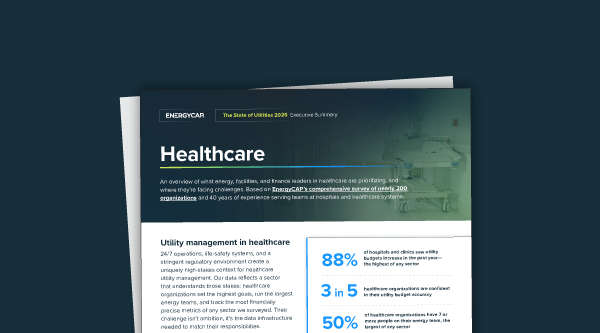
“Healthcare organizations don’t have an effort problem, they have a data problem.”
That’s the headline finding from EnergyCAP’s 2026 State of Utilities survey, and it shapes everything else we found about how health systems are managing energy costs today. We surveyed nearly 200 energy, facilities, and finance leaders across industries, and healthcare stood out on nearly every metric that matters.

Here are two takeaways that stood out:
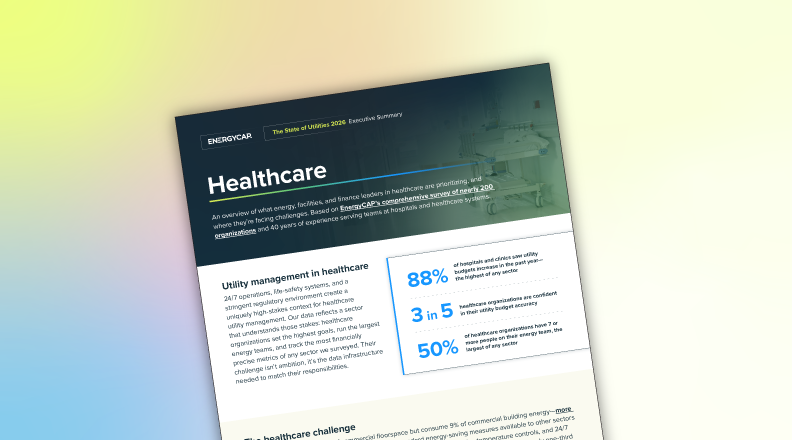
88% of hospitals and clinic respondents saw utility budgets increase in the past year, the highest rate of any sector we surveyed. But the raw percentage only tells part of the story—healthcare organizations were nearly 50% more likely than other industries to report double-digit cost spikes of 10% or more.
What makes it harder is that healthcare can’t reach for the standard energy-saving playbook. Mandated ventilation rates, strict temperature requirements, air change standards, and 24/7 operations remove many of the most common efficiency levers available to other industries. ENERGY STAR® estimates that up to 30% of a typical hospital’s energy use could still be eliminated through best practices and equipment upgrades—but finding that 30% requires precision, not just effort. For systems already managing thin operating margins, the stakes of getting this right keep rising.
71% of healthcare respondents cited improving budget and forecast accuracy as a top goal for 2026. That’s 1.5× the cross-industry rate—the largest goal differential of any sector we measured.
This need makes sense when you consider the context. Hospitals budget utilities months in advance across complex, multi-facility portfolios. Costs are tied directly to clinical operations that can’t be scaled back and aren’t always predictable. And unlike most commercial sectors, a budget miss in healthcare creates not only a financial variance, but pressure on operational decisions that have real consequences for patients and staff. This makes defensible, accurate forecasting a necessity for smooth clinical operations.
There’s more in the data, including findings about healthcare energy teams that will definitely surprise you.
Check out the EnergyCAP State of Utilities 2026 executive summary for the full picture: benchmarks, trends, and practical guidance built specifically for health system energy and finance teams.
Get the State of Utilities 2026 executive summary for healthcare