Headquarters
EnergyCAP, LLC
360 Discovery Drive
Boalsburg, PA 16827
Denver, CO
Suite 500
5445 DTC Parkway
Greenwood Village, CO 80111
Dublin, Ireland
Unit F, The Digital Court, Rainsford Street,
Dublin 8, D08 R2YP, Ireland
Phone: 877.327.3702
Fax: 719.623.0577
State and local government energy teams face a challenge no other sector deals with quite the same way: costs that move, and budgets that can’t.
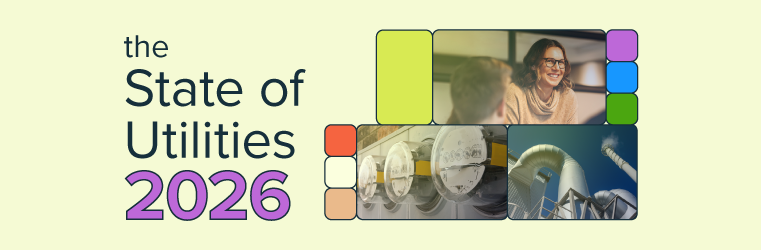
That’s the defining finding from EnergyCAP’s 2026 State of Utilities survey, and it shapes everything else we found about how government energy teams are managing utility costs today. We surveyed nearly 200 energy, facilities, and finance leaders across industries, and government stood out as a sector under unique and compounding pressure.

Here are two takeaways that stood out:
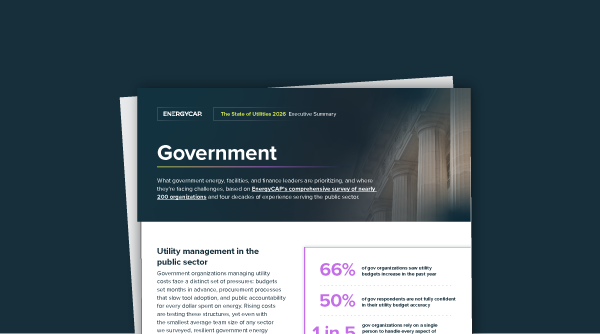
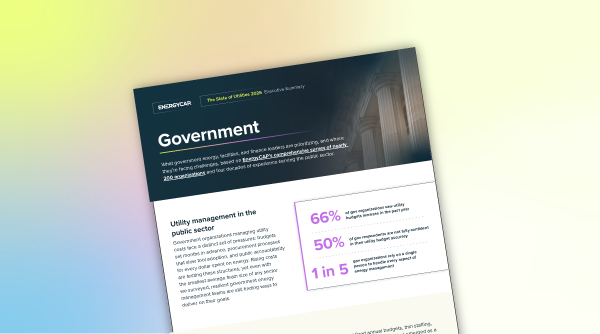
66% of state and local government respondents saw utility costs increase in the past year. The challenge isn’t just the increases themselves, but the structural constraints that prevent government teams from responding the way other sectors can. With budgets set 12 to 18 months in advance, absorbing such large and unexpected increases is difficult. State and local governments also reported the smallest energy team size of any sector we surveyed, meaning they’re already trying to do more with less as utility price hikes hit.
What makes this especially consequential is public accountability. Every dollar spent on utilities is a dollar that should be defensible to elected officials, oversight bodies, and the public.
46% of government respondents cited improving billing accuracy and reducing rework as a top goal for 2026, compared to just 31% across all industries. The underlying issue with billing accuracy is often how those bills are centralized and tracked – if it’s in spreadsheets, the errors that compound across dozens of accounts rarely surface until someone goes looking
Government organizations rarely have the staff to systematically audit utility bills for errors, unusual charges, or usage anomalies. Yet 1 in 5 utility bills processed by EnergyCAP contain errors. For organizations where every dollar is subject to public scrutiny, this poses both financial and accountability questions.
Check out the EnergyCAP State of Utilities 2026 State and Local Government Executive Summary for the full picture: benchmarks, trends, and practical guidance built specifically for state and local government energy and finance teams.
Get the State of Utilities 2026 executive summary for government