Headquarters
EnergyCAP, LLC
360 Discovery Drive
Boalsburg, PA 16827
Denver, CO
Suite 500
5445 DTC Parkway
Greenwood Village, CO 80111
Dublin, Ireland
Unit F, The Digital Court, Rainsford Street,
Dublin 8, D08 R2YP, Ireland
Phone: 877.327.3702
Fax: 719.623.0577
If you manage a growing mix of solar, storage, and PPAs, you’ve felt the sprawl of production in one portal, bills in another, credits buried in PDFs, and a spreadsheet holding it all together. Renewable energy management software brings the financial and environmental picture into one place by normalizing utility bills, interval and submeter data, onsite generation totals, tariffs, bill credits, and greenhouse gas (GHG) calculations.
But renewable energy management software doesn’t replace every tool you use, and it shouldn’t. The best platforms integrate with asset performance and commercial asset systems to capture equipment health and PPA details. Below, learn the benefits, common solution types, and how to choose what fits your organization.
Renewable portfolios quickly create financial, operational, and reporting complexity. Without a central system to align data and context, month-end becomes detective work, and year-end questions pile up. A dedicated platform helps by providing:
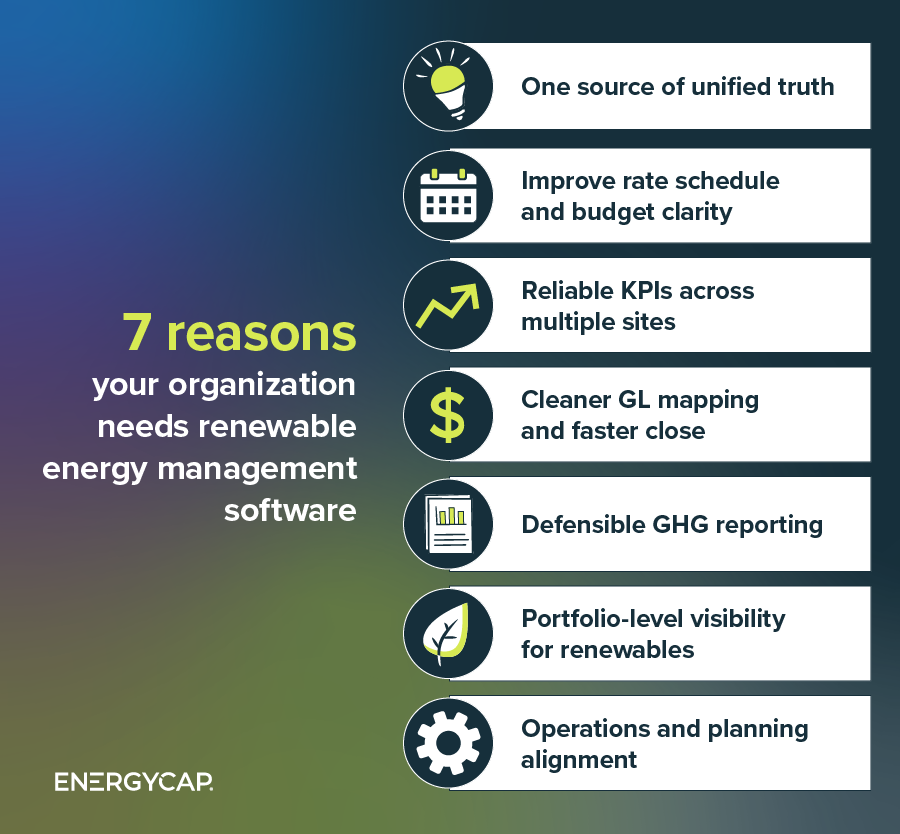
This foundation also enables other tools to do their jobs better. Asset performance systems can focus on equipment health, while commercial asset platforms manage PPAs, each informed by accurate costs, usage, and emissions from your renewable energy management software.
When costs, usage, and generation live in a single system, guesswork disappears, and trends become clear. Below are concrete benefits you can expect, plus what to track, so improvements show up in your quarterly reports.
As portfolios add solar, storage, and PPAs, your stack typically spans four types of energy management tools: sustainability and ESG reporting for GHG inventories and disclosures, asset performance management (APM) for equipment health and uptime, commercial asset management (CAM) for contracts, PPAs, and revenue, and enterprise energy management (EEM) for utility bills, rates, budgets, and portfolio analytics.
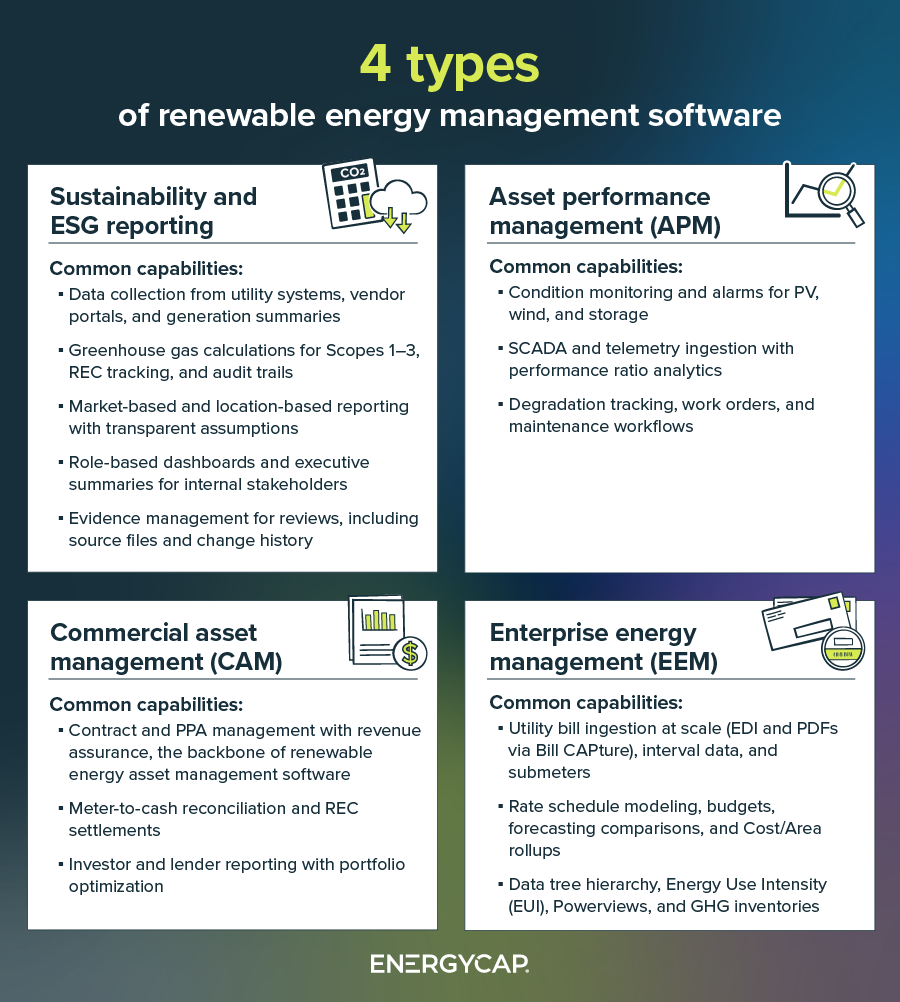
Common capabilities:
Example platforms:
Sustainability software translates verified activity data into clear greenhouse gas inventories and internal reports. Regardless of external frameworks, governance, transparency, and repeatability still matter. Solutions like EnergyCAP Emissions focus on accurate GHG accounting grounded in utility and generation data. They provide location- and market-based views, REC handling, and an audit trail that finance and sustainability teams can reuse across monthly and annual reviews.
Pro Tip: Strengthen your internal reporting with energy sustainability reporting best practices to improve data quality, governance, and stakeholder clarity.
Common capabilities:
Example platforms:
APM keeps assets healthy and productive; it focuses on real-time telemetry like strings, inverters, trackers, and batteries. You can use APM to detect faults, quantify lost production, and document availability, then pass summarized performance data to EEM and CAM systems. That linkage supports downtime analysis, curtailment review, and warranty claims while tying results back to costs, credits, and contracts.
Common capabilities:
Example platforms:
Commercial asset management (CAM) is often described as renewable energy asset management software, used by owners and operators to manage contracts, PPAs, revenue, and REC settlements. You can share summaries with EEM systems to align export credits, curtailment impacts, and PPA true-ups with the GL and site budgets. Connect CAM with APM to reconcile expected output versus downtime, and with ESG tools to ensure REC movements align with your GHG reporting.
Common capabilities:
Example platforms:
EEM is the backbone for costs, usage, and generation across sites. Tools like EnergyCAP Utility Management normalize bills and intervals, apply rate schedules, and map data to the GL, while Interval Data surfaces exceptions and portfolio trends. Emissions then uses the same verified data to produce transparent greenhouse gas inventories. Together, they create a trusted foundation that feeds APM, CAM, and reporting tools with consistent facts.
Pro Tip: Before you choose tools, ground your program in verified utility data. Learn why utility data is the first step in your sustainability strategy.
Picking the right platform starts with clarity. Define the outcomes you need, such as lower total cost, reliable KPIs, and defensible GHG math, then test vendors against real portfolio data. Use these steps to move from broad options to a confident decision.
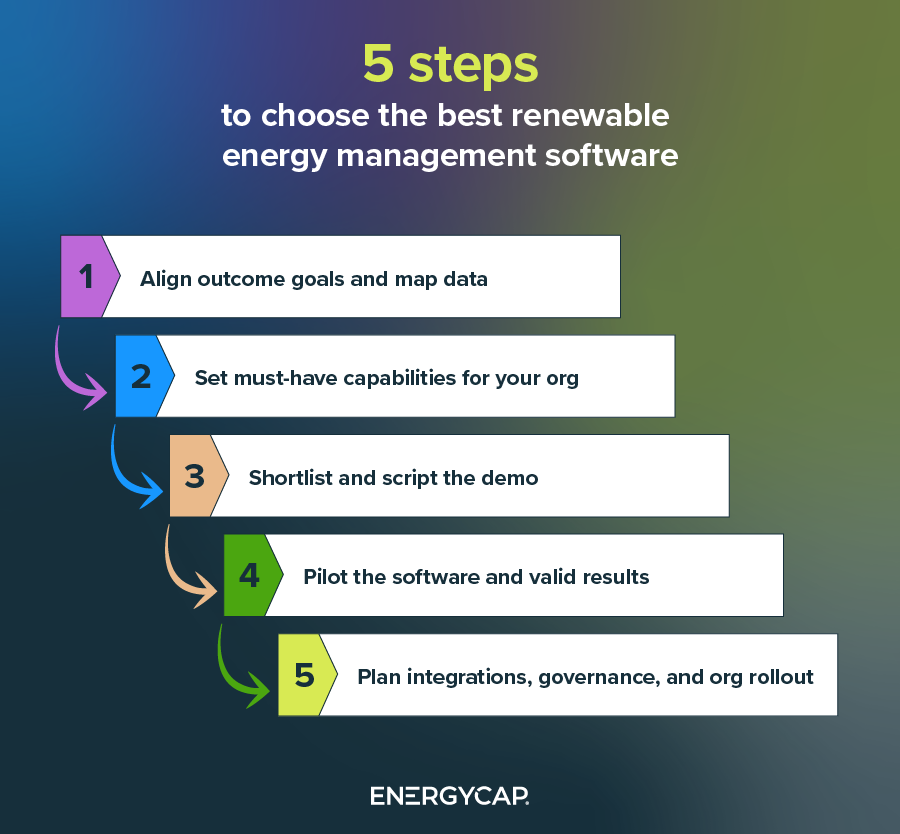
Write down what success looks like: EUI improvements, Cost/Area reductions, credits realized, fewer audit findings, and days to close. Next, inventory your data sources and structure, including utilities, interval meters, submeters, onsite generation, PPAs, and storage. Note formats such as EDI, PDFs for Bill CAPture, and flat files. For a structured process, see how to spec and purchase an ERP to align stakeholders, scope, and budget.
List nonnegotiables, such as rate schedule modeling for demand charges, netting, and bill credits. Then include budgets with variance tracking, GL mapping and exports, location-based and market-based GHG with REC handling, validation rules, exception handling, and audit trails. Don’t forget to confirm role-based access for energy, AP, sustainability, and operations.
Renewable energy project management software features to look for include:
Pro Tip: If your scope includes construction or EPC workflows, consider project management software for renewable energy and ensure it can share milestones and closeout data with your EEM platform.
Bring your own bills, intervals, and a sample PPA; ask vendors to model tariffs, credits, and REC logic live. Then, watch portfolio report speed, how results roll up across the data tree, and how exceptions are flagged. Finally, capture what each team member needs to see to do their job.
If you’re headed into a vendor demo, use these 15 questions to ask before you buy an ERP to sharpen requirements and avoid surprises.
Run one quarter in parallel, then compare forecast versus actuals, GL exports, and GHG outputs. Track hours saved, exception volume, and data completeness. Then, gather feedback from each user group and note what still feels manual.
Confirm APIs and flat-file exchanges with APM, CAM, and ESG tools. Then set rules for source file retention, change history, ownership of data quality, and rate updates. Be sure to budget for licenses, services, historical backfill, internal lift, and time-to-value. Lastly, schedule training, migration, and cutover milestones for your organization.
Renewable assets deliver real value when costs, usage, and generation roll up cleanly. With an enterprise energy management foundation, you can model rate schedules accurately, tie credits to budgets, and produce reliable GHG inventories that stand up to review. If you are evaluating GHG tools, compare capabilities to choose the best sustainability reporting platform.
Ready to see it in action? Take a tailored walkthrough of EnergyCAP Utility Management, Emissions, and Interval Data. Request an EnergyCAP demo and experience expert-driven energy management software.
Energy managers use a mix of renewable energy project management software solutions to keep their portfolio running efficiently.
EnergyCAP Utility Management, Interval Data, and Emissions cover the EEM and GHG foundation that other tools rely on.
Organizations often organize work into three energy management programs:
Together, they align budgets, site performance, and generation strategy with portfolio goals.
PV software generally falls into three buckets.
EEM platforms, such as EnergyCAP, complement PV software by connecting production and credits to utility costs and budgets.
Renewable energy management is the coordination of financial, operational, and environmental data across generation, storage, and load. The goal is transparent reporting and better decision-making on costs, risks, and greenhouse gas performance.
EEM provides the system of record that normalizes bills, intervals, generation totals, rate schedules, and RECs for consistent portfolio reporting.
Battery and hybrid portfolio optimization features are typically found in APM and CAM platforms that model dispatch, availability, and commercial terms. Use those tools for real-time or day-ahead decisions.
Use EEM for the cost and tariff context that shows how battery strategies affect demand charges, credits, and budgets. EnergyCAP supplies the verified utility and GHG data that optimization models need for accurate outcomes.