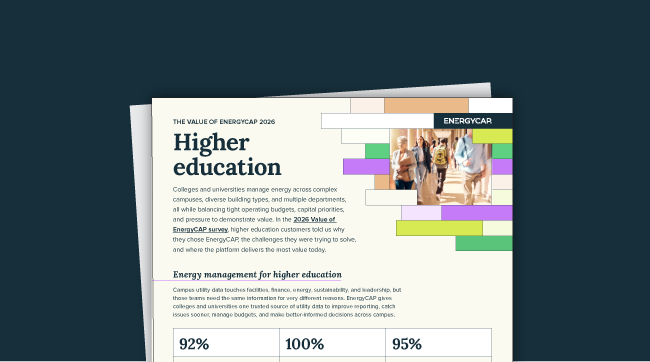






Higher education institutions are being asked to do more with less. Facilities teams are managing complex campuses and aging infrastructure, finance teams are watching operating budgets closel...



Headquarters
EnergyCAP, LLC
360 Discovery Drive
Boalsburg, PA 16827
Denver, CO
Suite 500
5445 DTC Parkway
Greenwood Village, CO 80111
Dublin, Ireland
Unit F, The Digital Court, Rainsford Street,
Dublin 8, D08 R2YP, Ireland
Phone: 877.327.3702
Fax: 719.623.0577

Facility maintenance is the coordinated practice of keeping building systems, assets, and spaces safe, reliable, and compliant. It spans preventive, predictive, corrective, and reactive work. This includes inspections and testing, vendor coordination, and documentation.
Unplanned downtime can be expensive for businesses. Siemens reports that losing just one hour can cost anywhere from $36,000 in the Fast-Moving Consumer Goods sector to $2.3 million in the Automotive industry. These risks add to the challenges facilities teams face, including aging equipment, limited resources, budget constraints, and higher energy costs.
Our facilities maintenance guide explains why maintenance is essential for your building and staff, covers the main types of maintenance with real examples, highlights common challenges, and offers practical tips to help you improve your approach.
When systems go down, everything slows down—people complain, leaders ask questions, and costs climb. Facilities and maintenance teams face aging equipment, tight budgets, and rising utility bills. A clear facility program keeps work moving and gives your team room to breathe.
Strong maintenance practices also strengthen compliance and extend asset life, while linking work orders to energy and utility insights helps you spot waste and plan upgrades with confidence.
Most organizations blend four approaches to match risk, resources, and asset criticality. The core facility types are preventive, predictive, corrective, and reactive maintenance. The right mix reduces surprise failures, improves safety and compliance, and makes budgets more predictable; this is especially true when supported by building maintenance software.
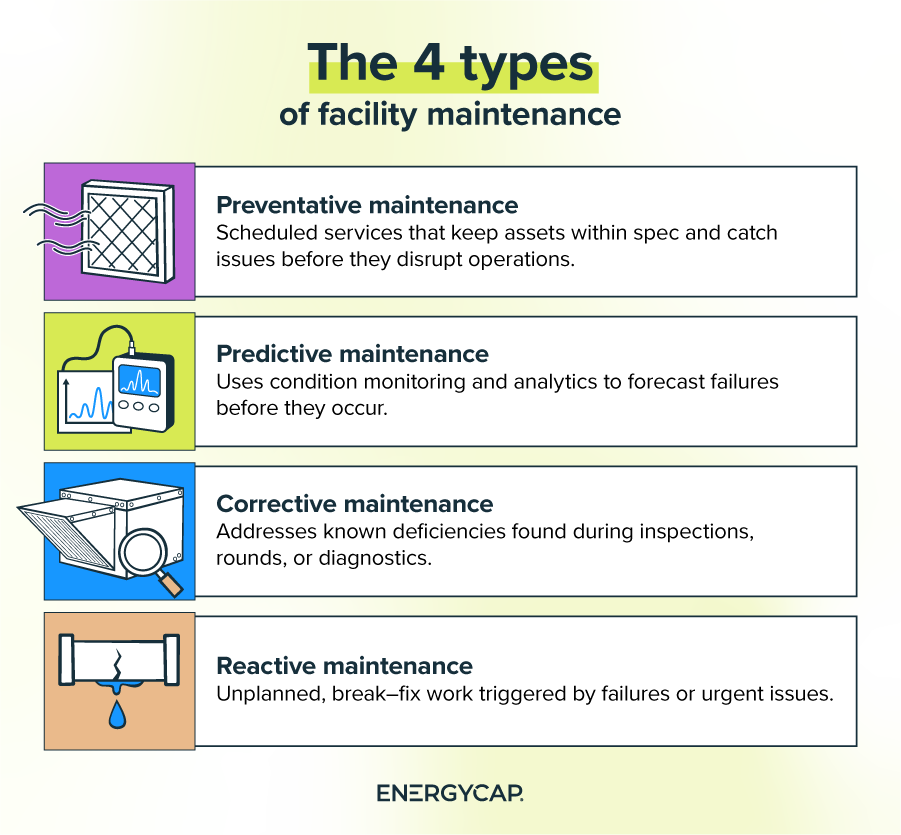
Preventive maintenance is scheduled, recurring services based on time or usage that keep assets within manufacturer specs and catch issues before they disrupt operations. The approach lowers emergency callouts, stabilizes parts planning, and supports code and insurance requirements. Tying PM tasks to meter and billing data in EnergyCAP is one way to help confirm savings and prioritize the systems that move costs.
Maintenance examples:
Predictive maintenance uses condition monitoring and analytics to forecast failures before they occur. Teams track vibration, temperature, pressure, and runtime trends to intervene at the right moment, helping reduce unplanned downtime and optimize parts and labor. Meter and billing insights in Utility Management and Interval Data help you separate asset issues from normal load swings.
Common assets covered:
Maintenance examples:
Corrective maintenance
Corrective maintenance addresses known deficiencies found during inspections, rounds, or diagnostics. Work is planned and scheduled, so assets return to proper performance without emergency disruption; this includes replacing worn parts, correcting settings, or making minor repairs. Tying work orders and costs to meters and rate schedules makes it easier to confirm that fixes reduce consumption and spend.
Common assets covered:
Maintenance examples:
Reactive maintenance is unplanned, break–fix work triggered by failures or urgent issues. It focuses on restoring service quickly to protect safety and operations. Standardized triage, clear SLAs, and tight vendor coordination to help teams respond faster, capture downtime, and control emergency spend. After the fix, confirm true impact with utility bills for M&V.
Common assets covered:
Maintenance examples:
Facility maintenance management is the day-to-day system that keeps requests moving, keeps preventive work on schedule, holds vendors accountable, and keeps records audit-ready. It turns scattered tasks into repeatable workflows your team can trust, even when staffing is thin. Follow these practical examples that facility teams run every week:
Standardizing these processes reduces fire drills, shortens audits, and makes budgets more predictable, especially when your facility maintenance software and energy data live in the same system of record.
Facility teams juggle aging systems, thin staffing, rising utility costs, and nonstop requests. Budgets and leadership expectations keep tightening, so the work has to be both faster and better documented to reduce risk and prove results. Without a clear framework, reactive fixes crowd out preventive work, and the backlog grows.
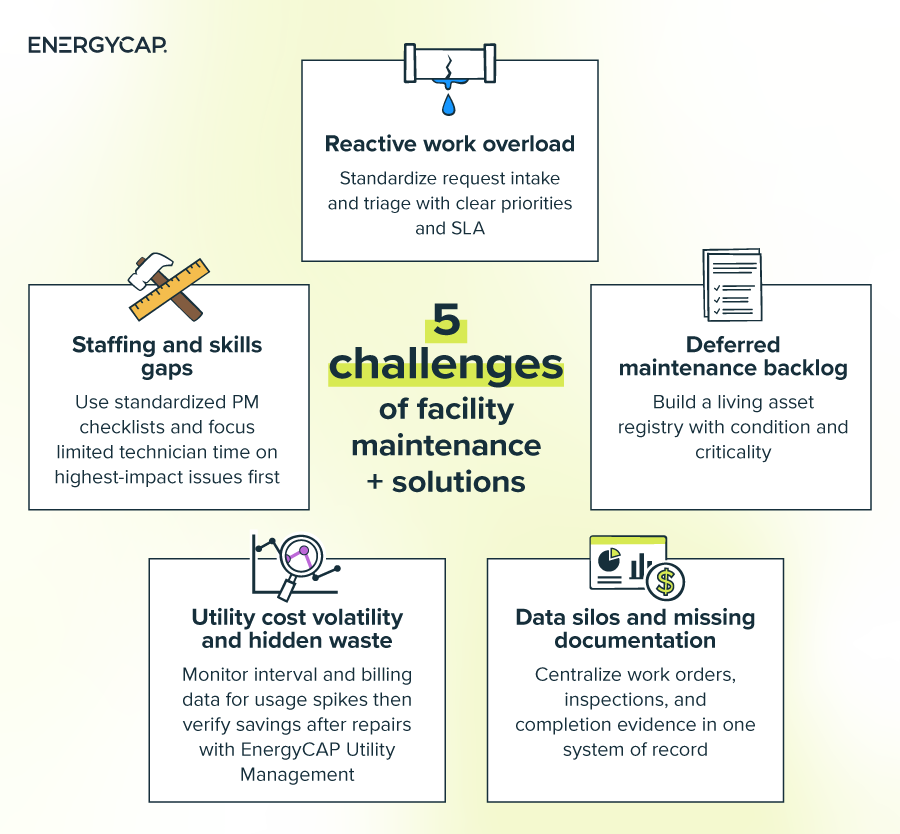
Solution: Standardize request intake and triage with clear priorities and SLAs, expand preventive routes for critical assets, and track work mix trends to target a healthier preventive–corrective–reactive balance.
Solution: Build a living asset registry with condition and criticality, bundle high-impact tasks during seasonal windows, and use downtime and cost history to justify funding.
Solution: Centralize work orders, inspections, photos, and completion evidence in one system of record; connect meter and billing data so that Powerviews in Interval Data can link maintenance to energy results
Solution: Use standardized PM checklists and prioritized routes, build quick-reference procedures, and focus limited technician time on the highest-impact issues first with simple, data-informed alerts
Solution: Monitor interval and billing data for usage spikes, demand ratchets, and leak signatures; tie findings to specific fixes; verify savings after repairs with Utility Management
Facilities work touches every part of a building, from HVAC and plumbing to life safety and utilities. Clear handoffs, defined scopes, and shared data help teams respond faster, avoid rework, and keep people safe. Below, we outline the key facility maintenance roles you’ll collaborate with day-to-day and the certifications that signal proven skills for high-risk or specialized work.
Pro Tip: Use one system of record to coordinate internal teams and facility maintenance companies across sites, scopes, and schedules.
Effective operations depend on a mix of strategic leaders, hands-on technicians, and specialists who can diagnose issues quickly and document what was done. Aligning responsibilities reduces gaps, shortens response times, and maintains consistent work across locations. In addition to a facility manager who oversees budgets, strategy, vendors, and compliance, companies might have:
For broader context, see our guide on facility management, which also explores how you can reduce downtime and risk, improve Energy Use Intensity (EUI), and support greenhouse gas (GHG) tracking.
Certifications signal proven skills, help standardize practices, and support compliance. Prioritize credentials that match your asset profile and risk, then track renewals alongside training records to keep crews qualified for regulated work.
Progress starts with clear priorities, simple routines, and visible results. Focus your team on the few practices that lower risk, reduce surprises, and prove value to leadership. Here are seven tips you can roll out across sites without adding headcount.
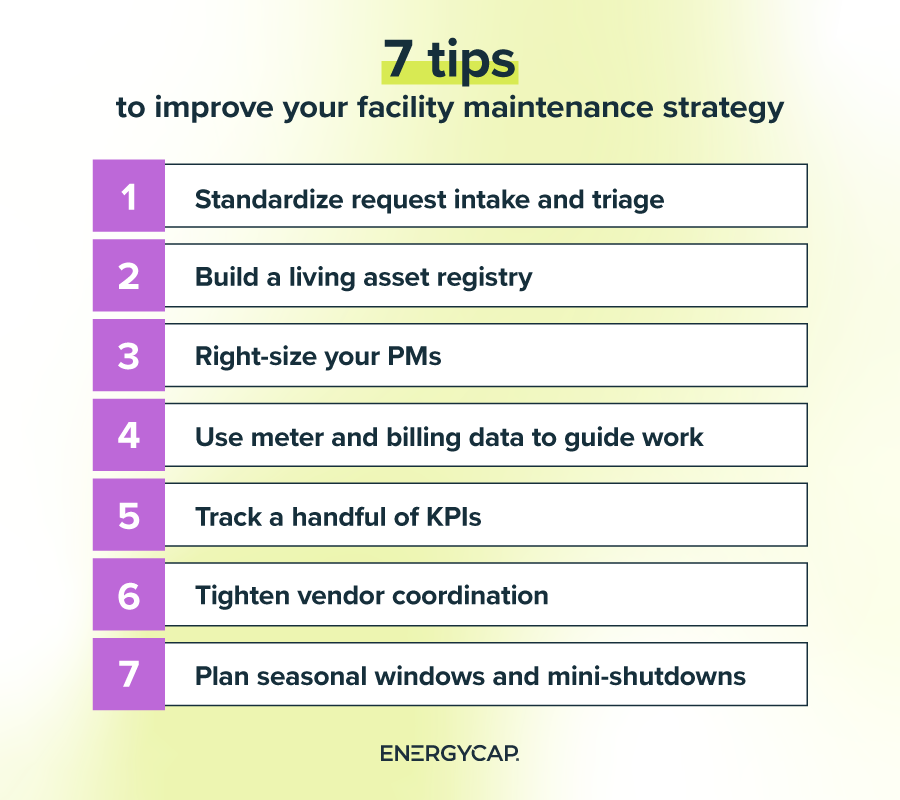
Start small, measure what matters, and keep your data in one place. These steps reduce fire drills, make budgets more predictable, and turn maintenance into a repeatable system. When facilities maintenance software and energy insights work together, budgets become more predictable.
Strong maintenance is not just fewer break-fix calls; it is safer buildings, steadier budgets, and clear proof that your decisions reduce risk and cost. When work orders, utility bills, interval data, and reporting live in one place, you can spot waste faster, validate repairs, and plan upgrades with confidence.
Take the next step and connect maintenance actions to measurable savings by requesting an EnergyCAP demo. See why organizations choose EnergyCAP to centralize utility data, streamline processes, and deliver results. Explore self-guided demos to preview Utility Management, Interval Data, Emissions, and Bill Capture.
Maintenance decisions show up on your utility bills. Well-tuned HVAC, controls, and plumbing reduce waste, avoid demand spikes, and prevent leaks that inflate charges. Tracking work orders alongside meter and billing data links a repair to a measurable change in Energy Use Intensity and cost. Utility Management and Interval Data help you verify savings, monitor trends, and prioritize the systems that move the budget.
Start with a clear framework that is easy to run across sites:
Most teams rely on a mix of facility maintenance software and building systems. Core tools include work order and PM scheduling, mobile checklists, asset tracking, and compliance documentation. Building automation systems, submeters, and sensors provide operational data. EnergyCAP Utility Management, Interval Data, and Bill Capture add utility billing, interval data, and variance detection so you can connect maintenance actions to energy and cost results.
Strong managers blend technical depth with people, budget, and risk skills. Look for experience across HVAC, electrical, plumbing, and controls; knowledge of safety and codes; vendor and project management; and comfort with data and KPIs. Common credentials include IFMA CFM or FMP, BOMI SMA/SMT, OSHA 30 (General Industry), and EPA Section 608 for teams that handle refrigerants.
Many professionals start as maintenance technicians or trades specialists and progress to lead technicians, maintenance supervisors, building engineers, and facility managers. From there, paths include multi-site or regional leadership, capital projects, energy and utility analysis, or controls/BAS specialization. Lateral moves into EHS or construction management are also common in larger organizations.