Headquarters
EnergyCAP, LLC
360 Discovery Drive
Boalsburg, PA 16827
Denver, CO
Suite 500
5445 DTC Parkway
Greenwood Village, CO 80111
Dublin, Ireland
Unit F, The Digital Court, Rainsford Street,
Dublin 8, D08 R2YP, Ireland
Phone: 877.327.3702
Fax: 719.623.0577
Unexpected failures drain budgets with overtime, rush parts, vendor callouts, comfort complaints, and wasted energy, stacking up fast. Implementing an effective preventive maintenance program reduces budget hits by catching issues before they become costly. The average cost of an hour of unplanned downtime hovers around $25,000, with larger organizations seeing far higher losses.
Still, many teams remain more reactive than planned. A majority of facilities dedicate less than 40% of maintenance time to planned work, leaving money on the table and risk on the floor. We’ll help lay out a practical path forward, explaining core components, seven cost-focused steps, and the KPIs that prove progress across buildings, HVAC, electrical, plumbing, roofing, fleets, and even printers.
Emergencies are expensive, disruptive, and hard to staff. A proactive preventive maintenance program shifts work to planned windows, so you control timing, cost, and quality without overtime or last-minute vendor calls. Preventive work also trims energy waste. Clean coils, calibrated sensors, and verified schedules keep HVAC, pumps, and controls operating as designed.
Standard tasks and clear acceptance criteria catch small defects like loose terminations, worn belts, and clogged strainers before they become outages or safety issues. The discipline applies across your portfolio: building equipment, commercial HVAC, electrical systems, plumbing, roofing, even fleets and printers.
With work orders, parts, and labor tied to assets, you can spot high-cost outliers, justify repair-versus-replace decisions, and forecast with confidence, something finance will appreciate. Planned work creates the data trail you need to defend budgets and prove results over time.
A preventive maintenance program only works if the foundations are solid. These components align maintenance with business outcomes, make work repeatable across locations and shifts, and give you the data to prove what’s working.
Without your core components, maintenance tasks drift into “set and forget,” compliance slips, and costs creep back into emergencies, overtime, and energy waste.
Each component below reduces variation, shortens diagnosis time, and ties daily tasks to measurable results. Together, they help you plan work on your terms, avoid rework, and make smarter repair-versus-replace decisions.
A good preventive maintenance program is repeatable, measurable, and easy to adjust. Use these seven steps to move from ideas to consistent results across buildings, fleets, and critical equipment.
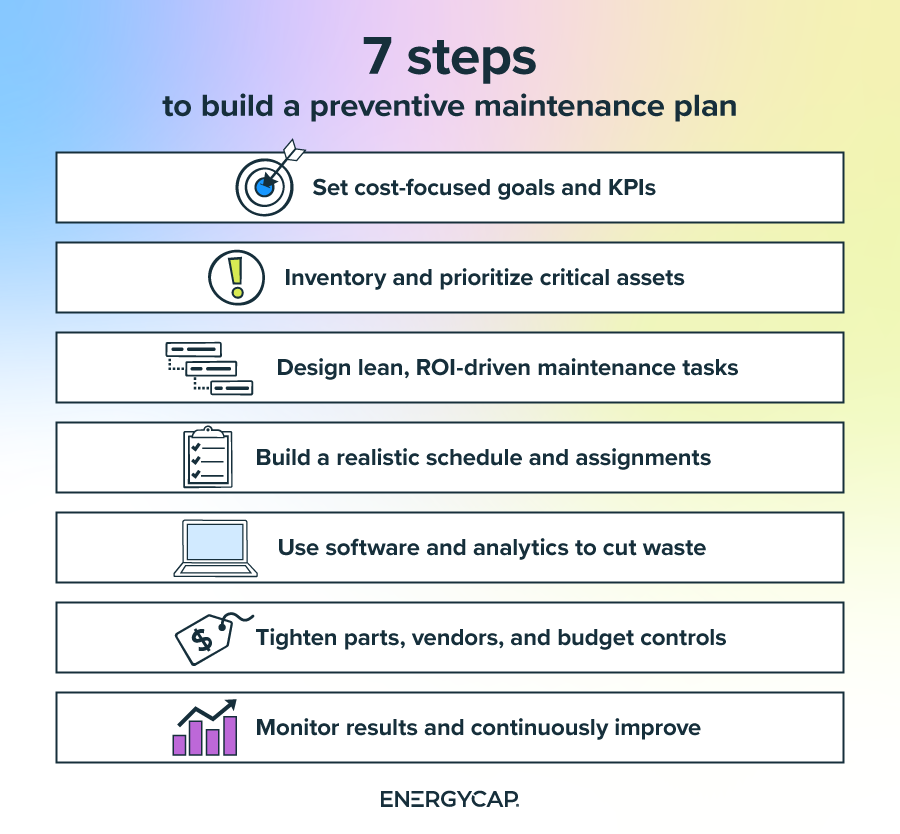
Start with business outcomes. Define targets for maintenance cost per unit, planned work ratio, preventive maintenance compliance, and unplanned downtime. Add energy objectives for HVAC, pumps, and controls so PMs reduce waste, not just failures. Write goals for each portfolio slice, building equipment, electrical systems, plumbing, roofing, fleets, and printers, so progress is visible at every level.
Recommended practices:
Build a complete asset list with locations, make and model, age, warranty status, and criticality. Prioritize assets where failure impacts safety, operations, or energy use most, such as chillers, boilers, air handlers, main switchgear, transfer switches, domestic water boosters, kitchen hoods, and fleet vehicles.
Recommended practices:
Write standard procedures that do only the work that pays off. Replace vague “inspect” steps with measurable checks and readings. Include energy-focused items that prevent drift in schedules, set points, sensor calibration, coil cleanliness, belt tension, and economizer function.
Recommended practices:
Balance preventive maintenance task frequency with technician capacity and operating windows. Stagger seasonal work to avoid crunch periods and overtime. Coordinate shutdown needs early with occupants and production.
Recommended practices:

Centralize tasks, work orders, and histories in your CMMS, then use energy management software to obtain a better understanding of your preventive maintenance program’s energy impact. The proper software helps organizations achieve cost-avoidance.
Recommended practices:
Control the input that drives cost by standardizing parts, setting reorder points for critical spares, and tracking vendor SLAs. Tie every part and labor hour to an asset and a work order.
Recommended practices:
Review KPIs monthly, perform a deeper quarterly review, and adjust frequencies or task scope based on results. Retire programs that never find defects and strengthen those that catch early failures or reduce energy use for greater cost savings.
Recommended practices:
Follow these steps, and your building preventive maintenance program becomes predictable, cost-focused, and manageable to defend—whether you are tuning a hotel preventive maintenance program, tightening an equipment preventive maintenance program in a plant, or formalizing a fleet preventive maintenance program for vehicles.
The right trigger keeps work lean and focused. In this section, we look at four task types: time-based, usage-based, condition-based, and run-to-failure. We’ll examine when each task type makes sense for cost, reliability, and energy performance.
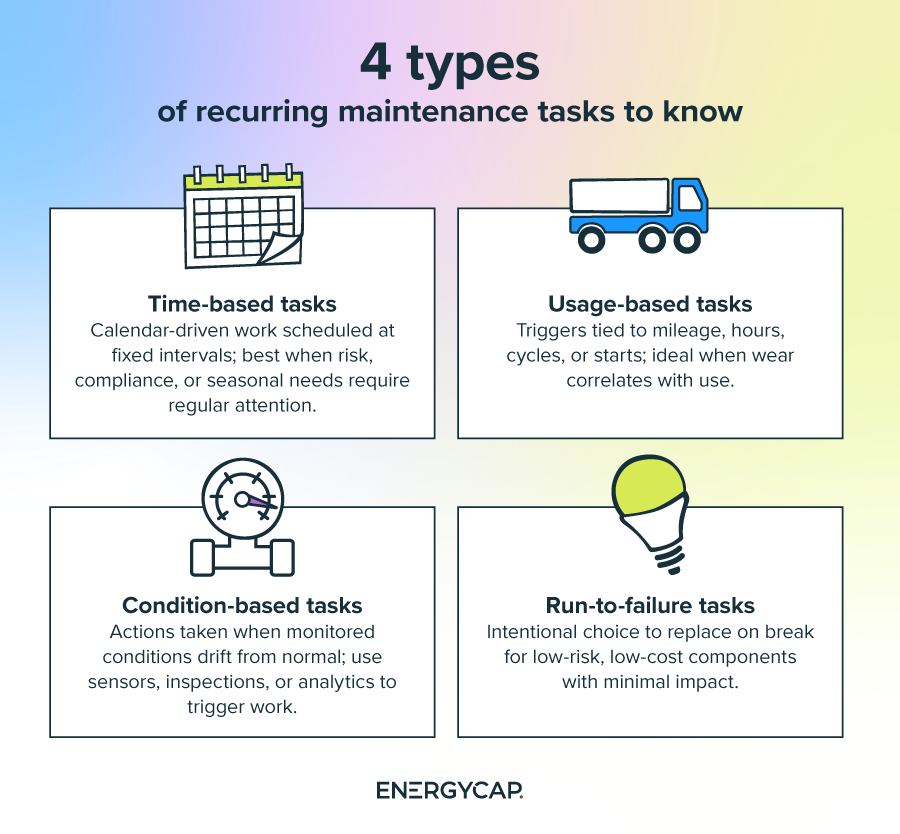
Calendar-driven work scheduled at fixed intervals; best when risk, compliance, or seasonal needs require regular attention. Time-based tasks are easy to plan, audit, and align with safety requirements. Keep an eye out, though, as it is possible to over-service low-use equipment. Consider reviewing frequencies annually and right-sizing to actual risk.
Example tasks:
Triggers tied to mileage, hours, cycles, or starts; ideal when wear correlates with use. Usage-based tasks reduce waste on lightly used assets and align with many OEM recommendations. This approach requires accurate meters or automated readings, plus clear rules for missed or reset counters.
Example tasks:
Actions taken when monitored conditions drift from normal; use sensors, inspections, or analytics to trigger work. Condition-based tasks help target true needs, cut premature maintenance, and lower energy use. You’ll need reliable data, thresholds, and review routines to avoid alarm fatigue.
Example tasks:
Intentional choice to replace on break for low-risk, low-cost components with minimal impact. Run-to-failure tasks avoid over-maintenance where preventive maintenance adds no ROI. For these tasks, be sure to document the rationale, keep spares on hand, and confirm that there are no safety, compliance, or comfort impacts.
Example tasks:
Effective KPIs turn maintenance work into business results. The right set of metrics helps you prove reliability gains, find cost and energy waste, and tune scope or frequency. Track them at the asset, site, and portfolio levels, and tie each metric to a clear data source.
Preventive maintenance works best when you can see the cost and energy impact in one place. The Business Intelligence integration add-on within Utility Management lets you combine CMMS, EnergyCAP, and financial data in your BI tools so you can analyze everything side by side.
Ready to connect your maintenance work to measurable results? See how EnergyCAP Utility Management, Smart Analytics, Carbon Hub, and Bill CAPture make it easier to control costs, reduce waste, and prove ROI. Request an EnergyCAP demo and start looking for savings.
Use a CMMS or EAM to schedule preventative maintenance activities, track labor and parts, and store asset histories. Use submeter data to track the energy savings from preventative maintenance activities and other conservation measures in EnergyCAP Smart Analytics.
Add Bill CAPture to automatically import invoice data, so you spot anomalies that point to failing equipment faster, while your team spends time correcting issues instead of entering bill data.
Define a simple scorecard and update it monthly: planned work ratio, maintenance compliance, unplanned downtime, defect closure time, repeat failure rate, and maintenance cost per unit. In your CMMS, use consistent codes for reactive, planned, and critical work.
In EnergyCAP, track submeter data aligned to your equipment, and use M&V, dashboards, and use intensity metrics to quantify the impact of maintenance changes.
Scope states what is included and excluded by building, system, and asset class; it clarifies responsibilities and service levels. The asset list is the detailed inventory: location, tag, make and model, age, warranty, criticality, and spare parts. Together, they drive maintenance priorities, staffing, vendor needs, and budget planning.
It is a scheduling tolerance that allows a task to be completed within 10% of its interval without counting as late. For example, a 90-day maintenance task can be done up to 9 days early or late and still be considered on time. Use this rule to level the workload, protect maintenance compliance, and avoid overtime caused by bunching.
A good checklist is specific, measurable, and safety-first. Include:
Common preventive maintenance program pitfalls boil down to unclear scope, weak prioritization, and poor data discipline. Vague inspection tasks, over-servicing low-use assets, skipping criticality ranking, and bunching work seasonally drag down maintenance compliance and ROI. Incomplete asset registries, missing spares, and inconsistent vendor practices add avoidable cost and downtime.
Avoid pitfalls with measurable checklists, usage- or condition-based triggers where appropriate, and a realistic schedule that uses the 10% rule to level workload. Keep the asset list current, set reorder points for critical parts, convert findings to corrective work orders with deadlines, and verify results after PMs.