





Higher education institutions are being asked to do more with less. Facilities teams are managing complex campuses and aging infrastructure, finance teams are watching operating budgets closel...



Headquarters
EnergyCAP, LLC
360 Discovery Drive
Boalsburg, PA 16827
Denver, CO
Suite 500
5445 DTC Parkway
Greenwood Village, CO 80111
Dublin, Ireland
Unit F, The Digital Court, Rainsford Street,
Dublin 8, D08 R2YP, Ireland
Phone: 877.327.3702
Fax: 719.623.0577
Utility data that doesn’t meet your audit standard isn’t useful, it’s a liability.
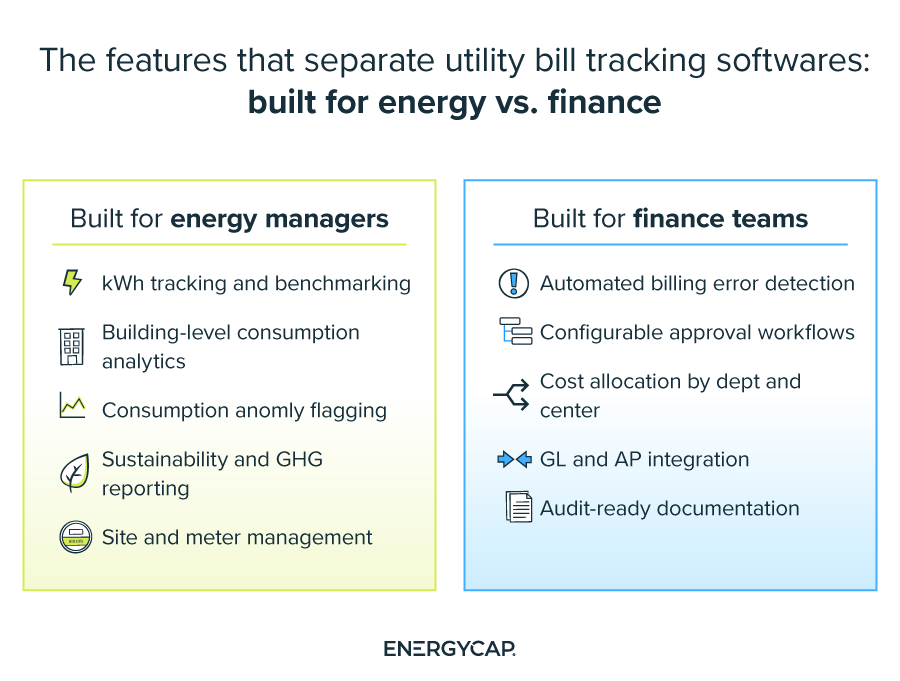
Most utility bill tracking tools were built for energy managers; tracking kWh, benchmarking buildings, and flagging consumption anomalies. Finance teams get handed the same tool and are expected to make it work for GL coding, period-end accruals, budgeting, variance reporting, and audit documentation. It rarely does.
When 76% of organizations are seeing utility costs rise year over year, and more than 1 in 5 are absorbing double-digit increases, the cost of late data, uncaught billing errors, and manual reconciliation isn’t theoretical. It shows up in budget variances, missed forecasts, and audit findings. Use EnergyCAP’s utility bill increase calculator to see what a rate increase costs your portfolio before you’re trying to explain it in a budget review.
For the 57% of organizations that measure program success by spend vs. budget variance, the tracking tool isn’t a back-office utility: it’s the source of record for one of your largest operating cost lines. It needs to meet the bar finance actually requires.
Here are the six features that separate utility bill tracking software built for finance teams from ones built only for energy and sustainability teams.
Billing errors are common, and most of them go undetected until after they’ve posted. EnergyCAP flags an average of 5% of utility bills every month with real, recoverable cost issues.
The error types that surface most often: overlapping billing periods, duplicate bills, repeat invoice numbers, and gaps between bills—the kinds of discrepancies that spreadsheet-based review misses because there’s no automated baseline to check against. The consequences range from paying for a billing period twice to missing bills entirely, which tacks late fees onto an already inaccurate budget.
EnergyCAP customers have recovered seven figures in a single billing dispute backed by platform data. When an error is this expensive and this easy to miss manually, automated validation isn’t a nice-to-have; it’s a control.
Finance teams that rely on spreadsheets for bill review are essentially auditing by exception — catching what stands out visually, when something happens to stand out at all. Automated validation catches what you can’t see.
Most finance teams currently route utility bills by email: forward to the right person, wait for a reply, hope the documentation trail survives an inbox search. That approach has no audit record, no documented approval chain, and no way to enforce GL coding consistency across approvers.
EnergyCAP’s approval workflow module routes bills through configurable chains: the right approver gets the right bill, GL coding is applied consistently, and every approval is timestamped and stored. When an auditor asks who approved a $40,000 bill in Q3, the answer is three clicks away.
Configurable routing also closes a real exposure: unauthorized spend. Without a workflow that enforces approval by amount, location, or commodity, bills can post without review. A documented, enforced chain prevents that—and produces the records to prove it.
Utility costs don’t belong in a single budget line for most multi-site organizations. They belong in the departments, cost centers, or tenant accounts that drove the spend, and finance teams are the ones expected to produce those splits accurately.
EnergyCAP supports two allocation methods. For organizations with submeters, allocations are driven by actual meter readings: precise, defensible, and directly traceable to the source. For organizations without submeters, which is the more common scenario, EnergyCAP supports formula-based splits using square footage, percentage rules, or other defined criteria.
Either way, the output is the same: each cost center, department, or tenant receives an accurate utility charge without manual calculation or spreadsheet intervention. The chargebacks are consistent, the methodology is documented, and budget variance reporting has a defensible foundation.
GL integration is typically the first question a finance team asks when evaluating utility bill tracking software, and the right answer isn’t just “yes, we export.” It’s about what the integration actually does.
EnergyCAP delivers pre-coded, validated utility data directly to the accounting system: GL codes applied, cost centers tagged, ready for journal entry. No manual re-entry between bill approval and posting. No reconciliation step between the energy platform and the accounting system.
The framing matters: EnergyCAP doesn’t replace your accounting system—it feeds it clean data. That distinction is important for finance teams who’ve watched other platforms create more reconciliation work than they eliminated.
For most finance teams, accruals are built from last year’s rates, averages, or best guesses, with hope the actuals don’t land far enough off to require a material adjustment.
EnergyCAP’s Accounting module generates accrual estimates from actual billing history and rate patterns, normalized for weather and location—data that reflects how your accounts have actually behaved, not what they cost the same month last year. Estimated amounts export to the GL and reverse automatically when the real invoice arrives.
This is the capability most energy management platforms don’t have, and the one finance teams rarely know to ask for until close is already painful. It moves accruals from a manual estimation process to a data-driven one, which means fewer surprises at month-end and more confidence in the numbers going into a forecast.
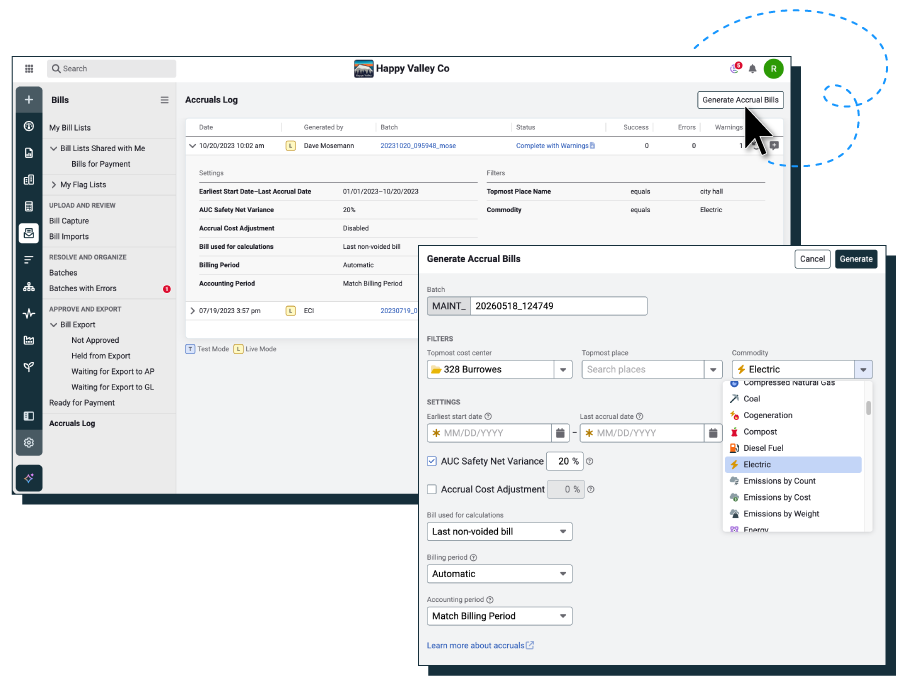
EnergyCAP's Accounting module generates accrual estimates from actual billing history and rate patterns
Audit readiness is a finance team necessity, not a preference. When the auditor asks for documentation on a utility invoice from 18 months ago, the answer has to be immediate and complete.
EnergyCAP centralizes scanned invoices, approval records, and bill history in a single searchable system. Auditors can be given read-only access to the database, which means they get what they need without touching anything they shouldn’t.
The alternative is assembling documentation from email archives, shared drives, and printed records under deadline. That’s the scenario EnergyCAP eliminates.
Choosing utility bill tracking software your finance team will actually use
Utility bill tracking is a different category from energy management software, and it’s a different category from general AP tools. The right platform catches billing errors before they post, integrates with the GL, automates accruals, and produces audit-ready records, all without adding reconciliation work or requiring a dedicated analyst to make it function.
For a broader look at how energy, facilities, and finance teams work from the same data, see utility data management. And if your team is also accountable for GHG reporting, emissions tracking software covers how utility and meter data connects directly to carbon reporting.
Utility bill tracking is a different category from energy management software, and it’s a different category from general AP tools. The right platform catches billing errors before they post, integrates with the GL, automates accruals, and produces audit-ready records, all without adding reconciliation work or requiring a dedicated analyst to make it function.
Explore how EnergyCAP serves finance teamsUtility bill tracking software centralizes invoice data across a multi-site portfolio, automates validation and approval workflows, and produces records finance teams can use for budgeting, cost allocation, GL posting, and auditing. It’s distinct from utility billing software, which generates invoices sent to customers, and from general energy management software, which focuses primarily on consumption analytics.
Purpose-built platforms export GL-coded utility data directly to the accounting system, eliminating manual re-entry between bill approval and journal entry. The depth of that integration—whether it handles GL coding, payment processing, and cost center tagging—is the differentiator that matters most to finance teams evaluating tools.
Yes: platforms like EnergyCAP generate estimated accrual amounts from actual billing history and rate patterns, export directly to the GL, and reverse automatically when the real invoice arrives. This is the capability most energy tools don’t have, and most Finance Managers don’t know to ask for until close is already a problem.
Allocation can be driven by submeter readings (precise, tied to actual meter data) or by formula-based rules such as square footage or percentage splits. Either way, each department or cost center receives an accurate utility charge without manual calculation or spreadsheet intervention.
Utility billing software generates invoices sent to customers—used by municipalities and utilities to bill their accounts. Utility bill tracking software manages invoices received from utilities on behalf of a multi-site organization. A finance team evaluating software for the latter sometimes lands in content about the former; if you’re managing incoming utility invoices across a portfolio, you’re in the right place.