





Holiday breaks represent one of the largest, and most frequently missed, energy-saving opportunities of the year. Buildings sit partially or fully unoccupied for days or weeks, yet HVAC system...



Headquarters
EnergyCAP, LLC
360 Discovery Drive
Boalsburg, PA 16827
Denver, CO
Suite 500
5445 DTC Parkway
Greenwood Village, CO 80111
Dublin, Ireland
Unit F, The Digital Court, Rainsford Street,
Dublin 8, D08 R2YP, Ireland
Phone: 877.327.3702
Fax: 719.623.0577
EnergyCAP hosted a webinar earlier this month on a topic that’s moving faster than most organizations realize: the growing web of energy and emissions compliance laws affecting building owners across the U.S. What used to feel like a California obligation is quickly spreading. If you manage buildings in multiple states, have compliance obligations you’re still figuring out, or are just trying to understand what’s coming, here’s what you need to know.
There are four main categories of energy and utility data compliance requirements in the U.S. today:
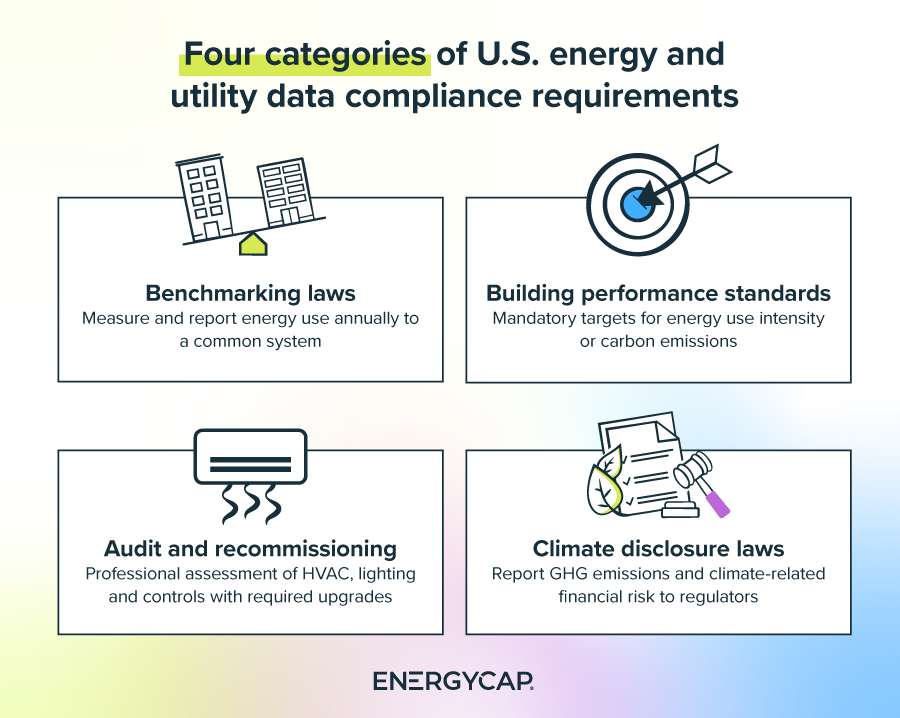
Benchmarking laws require large building owners to measure and report energy use to a common system—most often ENERGY STAR® Portfolio Manager®—at least annually. They’re the most widely adopted category, and they’re still expanding.
Building performance standards (BPS) go further by setting mandatory performance targets based on energy use intensity or carbon emissions. Benchmarking tells you how you’re doing, BPS tells you where you have to go.
Audit and recommissioning laws require professional assessment of your building systems like HVAC, lighting, and controls, and complete reasonable upgrades where practical. Less common today, but growing.
Climate disclosure laws are the newest category and the fastest-moving. Rather than focusing on the building itself, these laws require companies to disclose greenhouse gas emissions and climate-related financial risk. California’s SB 253 and SB 261 put these on the map, and other states are following suite.
Five years ago, benchmarking and climate disclosure laws were largely a coastal story. That’s no longer true. Meaningful activity is spreading across the Midwest, the South, and the Mid-Atlantic. A few notable developments from 2025 and early 2026:
The pattern is consistent: California and New York establish a framework, and other states adopt it. If you’re managing a multi-state portfolio, the question isn’t whether compliance will come to you, it’s when.
California’s SB 253 requires companies operating in California with over $1 billion in revenue to disclose scope 1 and 2 GHG emissions annually. The first reporting deadline is August 10, 2026. Scope 3 is delayed to 2027.
This year is a good-faith compliance year. Regulators aren’t issuing penalties for organizations that are genuinely trying to get their data in order. That grace period ends next year. Starting in 2027, penalties of up to $500,000 per entity per violation are on the table.
SB 261, the companion climate financial risk disclosure law, is a different story: it’s currently under injunction, working through the Ninth Circuit Court. About 120 companies have submitted voluntarily, but compliance is not yet mandatory.
Most benchmarking laws use ENERGY STAR Portfolio Manager as the reporting repository. After a period of uncertainty last year around federal funding, HR6983 was signed into law funding ENERGY STAR at $33 million, on par with 2024 levels and for the first time with its own dedicated line item.
ENERGY STAR is currently transitioning from the EPA to the Department of Energy. That transition plan is due in the coming weeks. One practical note: if you have submitted data to ENERGY STAR in the past, download and keep your own copy. As the program changes hands, having your own records is smart risk management.
Every one of these mandates: benchmarking, BPS, audit laws, climate disclosure, traces back to one requirement: accurate, traceable utility data covering at least a full calendar year.
That’s harder than it sounds. Utility bills arrive from dozens of vendors in different formats. Most organizations are managing them in spreadsheets. A 2024 study analyzed more than a decade of business-critical publications and found that 94% of spreadsheets contained errors that affected business outcomes—not typos, but errors with real financial and operational consequences.
On EnergyCAP’s own platform, one in five utility bills that come in has some kind of error—duplicate charges, estimated reads that are way off, account numbers that don’t match. Some of those errors cost money directly. Others create downstream problems in your emissions calculations or your compliance submissions.
When auditors scrutinize your compliance filings, they’re scrutinizing the data behind them. Traceability matters: the ability to get from your reported number all the way back to the source—the bill, the meter, the calculation—is what financial-grade data looks like. Spreadsheets rarely get you there.
EnergyCAP centralizes all of your utility, emissions, and meter data in one place—electricity, gas, water, steam, and custom commodities—with a full audit trail from bill to report. A few specific capabilities that matter in a compliance context:
ENERGY STAR integration: EnergyCAP submits data directly to Portfolio Manager®. No double entry, no manual transfers. Scores, certifications, and history sync back into EnergyCAP so everything lives in one place.
EnergyCAP Emissions: As bills enter EnergyCAP, they’re automatically converted into emission sources using EPA, eGRID, IEA, and other standard factors— location-based and market-based. Scope 1, 2, and 3 reporting is completely supported.
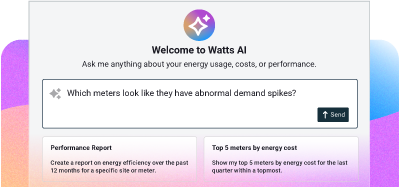
EnergyCAP Watts AI: Our AI engine is woven throughout the platform. Watts chat lets your team ask natural language questions and get answers drawn from your actual data, including your emissions and compliance history.
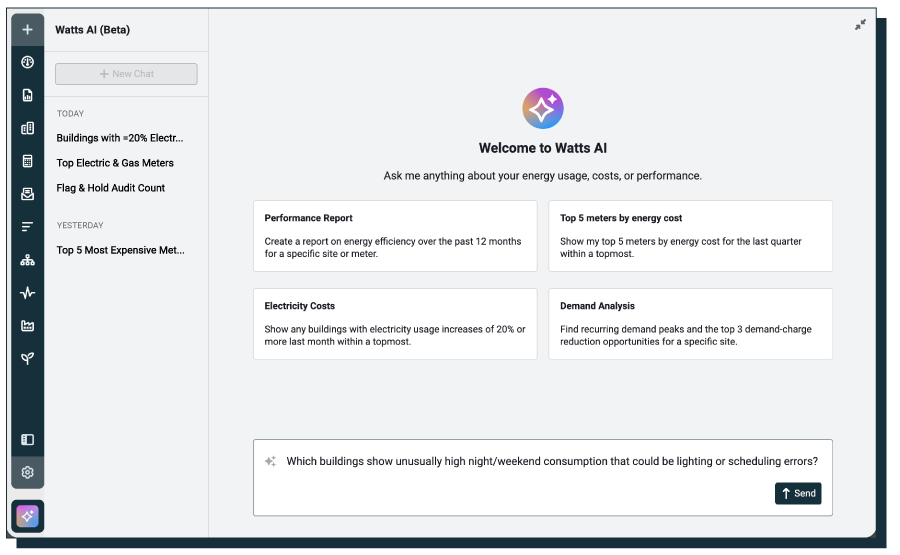
EnergyCAP Watts AI
The connection between kilowatt hours, dollars, and tons of emissions is what makes carbon reporting meaningful and what enables the full picture: cost avoidance, emissions avoidance, and building performance over time. That’s not possible when your data lives in spreadsheets.
Compliance deadlines are arriving in cities and states that weren’t on anyone’s radar two years ago. The organizations that are in good shape are the ones that already have their data centralized, accurate, and traceable. If yours isn’t there yet, now is the right time to take stock.