







Higher education institutions are being asked to do more with less. Facilities teams are managing complex campuses and aging infrastructure, finance teams are watching operating budgets closel...



Headquarters
EnergyCAP, LLC
360 Discovery Drive
Boalsburg, PA 16827
Denver, CO
Suite 500
5445 DTC Parkway
Greenwood Village, CO 80111
Dublin, Ireland
Unit F, The Digital Court, Rainsford Street,
Dublin 8, D08 R2YP, Ireland
Phone: 877.327.3702
Fax: 719.623.0577
If you work in facilities, you probably don’t need help filling your day. There’s always another building that needs attention, another project to plan, another report to prepare, or another question from leadership that needs an answer. So when we talk about saving time, the real question isn’t whether you can find something to do with the hours you get back. It’s how much of your time is being consumed before you ever get to the work that needs your expertise.
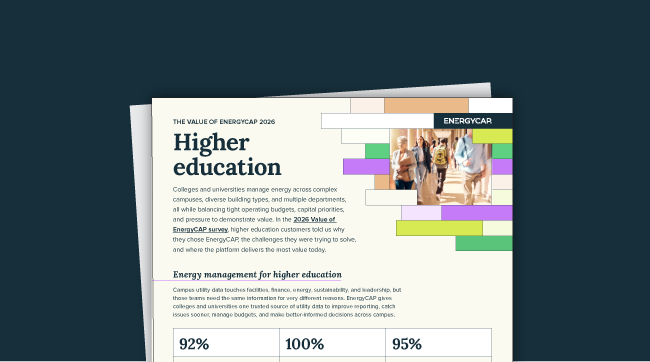
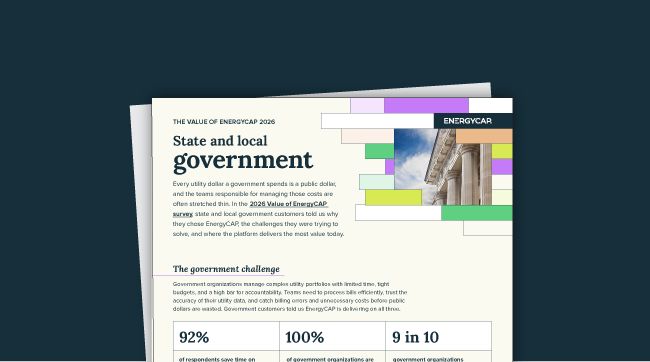
The 2026 Value of EnergyCAP survey offers some perspective. Among customers surveyed across more than 100 organizations, 92% said EnergyCAP saves time on utility bill processing, while 95% said it saves time on utility data management and analysis. Before EnergyCAP, the most commonly reported workload for collecting, entering, and validating utility data was more than 80 hours per month. After implementing EnergyCAP, most customers reported spending fewer than 20. That’s a significant difference. But to understand where the time savings come from, it helps to look at where time gets lost in the first place.
Time savings was one of the categories that stood out most across the results. If you have not already, you can read the three biggest takeaways from the full survey.

Utility management rarely consists of one big manual task you can point to and say, “There’s the problem.” Instead, time disappears in small, repeated steps. A bill has to get into the organization. Data has to make its way into the right system. Missing or questionable information needs to be resolved. Someone needs a report. A number doesn’t look right, so someone has to investigate whether it’s accurate. Facilities may not own every one of those steps, but you feel the friction they create when you need the information on the other side.
And scale changes the equation. A few minutes of manual work may not sound significant when you’re thinking about one bill or one building. Multiply those minutes across hundreds or thousands of bills, accounts and meters every month, and small touches can consume a surprising amount of time.
The same thing happens when you need to use the data again. A question from leadership, a budget discussion, or a building comparison can trigger another round of finding, checking, reconciling or preparing information. If every new question requires someone to prepare the data again, you’re spending time on the same information over and over.
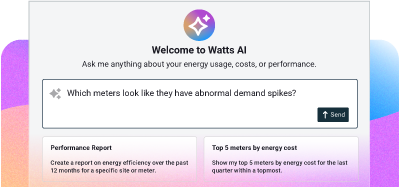
That’s where technology can change the equation. EnergyCAP can reduce manual work before utility information ever reaches facilities. Bill Capture automates much of the work involved in collecting, entering and validating utility bills, while automated audits help flag unusual usage, costs and other exceptions that deserve attention. Instead of requiring people to touch every piece of information, the process can help direct their attention to what actually needs it.
Once utility data is in EnergyCAP, it also becomes a consistent source for reporting and analysis. That means the time savings don’t have to end when the bill is processed. They can continue the next time you need that information for a report, a planning conversation or a question from leadership. The goal isn’t simply to make each manual task a little faster. It’s to remove unnecessary touches and shorten the path between having utility data and being able to use it.
A major North American retailer, with hundreds of locations and more than 230 utility vendors, shows what that can look like at scale. Before working with EnergyCAP, the accounts payable team spent 7–8 days processing utility bills each cycle, slowed by manual handling and limited automation across that many vendor relationships. After adopting EnergyCAP’s enhanced web capture with JSON ingestion, that turnaround dropped to 1–2 days. That’s a reduction of more than 75%.
But the bigger story isn’t simply the speed. It’s that the improvement required no changes to the team’s existing workflow at all. The automation happened behind the scenes, and the accounts payable team kept working the way they always had but with a week and a half of time freed up every cycle.
Don't look only at the work it makes faster. Look at the work it no longer requires someone to do.
If you want to understand where time may be hiding in your own utility processes, don’t start by asking how long it takes to complete a single task. Follow the data instead. How many people touch utility information before you can use it? How many systems does it pass through? Where does someone have to enter, check, reconcile or reformat it? When you need that information again three months later, is it ready to use—or does someone have to prepare it again?
Those individual touches are easy to accept as part of the job. At scale, they’re also where a surprising amount of time can hide. And that’s why the time-savings numbers in the Value of EnergyCAP survey matter. Hours saved are the measurement. Fewer unnecessary touches are how you get there. More time for the work that requires your expertise is the payoff. Facilities professionals don’t need more things to do. They need more of their time available for the work that matters.
See how much time EnergyCAP customers are getting back → Explore the 2026 Value of EnergyCAP report