




Higher education institutions are being asked to do more with less. Facilities teams are managing complex campuses and aging infrastructure, finance teams are watching operating budgets closel...



Headquarters
EnergyCAP, LLC
360 Discovery Drive
Boalsburg, PA 16827
Denver, CO
Suite 500
5445 DTC Parkway
Greenwood Village, CO 80111
Dublin, Ireland
Unit F, The Digital Court, Rainsford Street,
Dublin 8, D08 R2YP, Ireland
Phone: 877.327.3702
Fax: 719.623.0577
Higher education institutions are being asked to do more with less. Facilities teams are managing complex campuses and aging infrastructure, finance teams are watching operating budgets closely, and sustainability teams need reliable data to track progress and support reporting. Meanwhile, leadership expects each department to demonstrate value and make informed decisions about where limited resources should go.
Utility data sits at the intersection of all those priorities.
That is why the value of utility management for higher education goes well beyond paying bills or tracking energy consumption. When colleges and universities have one reliable source of utility information, then facilities, finance, sustainability, and leadership work from the same set of numbers.
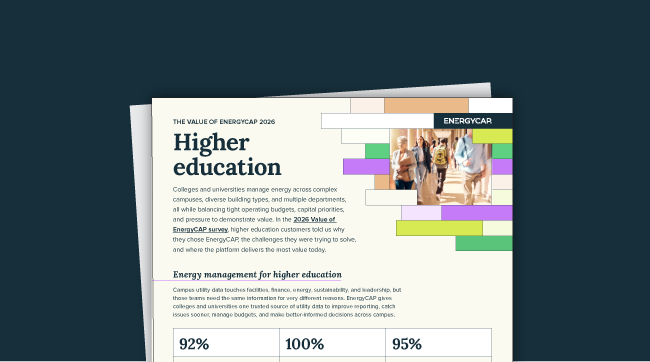
The 2026 Value of EnergyCAP survey makes that clear. We dove into what higher education customers specifically had to say, and they report value in five primary areas: utility bill cost savings, faster and more accurate reporting, improved budget management, better building operations, and improved data governance.
Before a university can benchmark buildings, validate an energy project, or report sustainability progress, it needs confidence in the underlying information.
Every single higher education respondent in the survey reported being more confident in the accuracy of their utility data with EnergyCAP. That foundation matters because campus utility information often serves many different audiences–facilities wants to know why a building is consuming more energy, while finance needs accurate accruals and budgets. Leadership often needs the data at a higher level: Are our investments paying off?
Higher education customers also expand how they use that data over time: they use EnergyCAP for nearly 50% more reasons than they originally purchased it for, with growth in areas including collaboration, sustainability reporting, budgeting, utility cost savings, and procurement.
One of the most immediate opportunities is also one of the simplest: find billing errors that save cost without having to spend capital dollars on energy conservation projects.
Across EnergyCAP customers, 88% report saving money from billing issues, overcharges, and errors, with organizations reporting an average annual recovery equal to 3% of total utility costs. Higher education performs even better: 95% report uncovering savings from billing errors, overcharges, and other discrepancies.
That is substantial savings without a new chiller to purchase, or building retrofit to fund. It is money that can potentially be returned to the budget and reinvested elsewhere (often called a green fund).
Pepperdine University offers a great example. After EnergyCAP flagged what initially looked like an irrigation inefficiency, the university discovered a significant utility billing error. Pepperdine reports that identifying utility mistakes and cost discrepancies has helped it capture more than $500,000 in savings.
Money isn’t the only scarce resource on campus. Staff time is, too.
Among higher education respondents, 92% save time on bill-processing activities after implementing EnergyCAP, with benefits extending beyond the energy office into facilities, accounting, and accounts payable.
Every hour spent collecting bills, maintaining spreadsheets, reconciling numbers, and manually preparing reports is an hour that isn’t being spent analyzing buildings, identifying opportunities, planning projects, or improving operations.
For campus teams already stretched thin, automation changes the equation. Utility management becomes less about moving data around and more about using it.
This is where the survey results for higher education were particularly interesting.
Colleges and universities are 1.6 times more likely than customers overall to report better building operations as a benefit of EnergyCAP. Trusted utility and interval data help facilities teams identify unusual consumption, investigate inefficient buildings, compare performance, and prioritize where staff time and capital spend should focus.
Ultimately, that is where the biggest cost saving opportunity lies. EnergyCAP’s overall customer research found that 79% use the platform’s data to identify energy conservation measures and cost-avoidance opportunities, with ECM savings averaging 5% of annual utility spend.
For higher education, utility data becomes much more valuable when it can be utilized by every department.