






If you’re justifying energy management software based on hours saved, you’re overlooking the biggest opportunities to reduce utility costs. Imagine walking into your CFO’s of...


Headquarters
EnergyCAP, LLC
360 Discovery Drive
Boalsburg, PA 16827
Denver, CO
Suite 500
5445 DTC Parkway
Greenwood Village, CO 80111
Dublin, Ireland
Unit F, The Digital Court, Rainsford Street,
Dublin 8, D08 R2YP, Ireland
Phone: 877.327.3702
Fax: 719.623.0577
If you’re justifying energy management software based on hours saved, you’re overlooking the biggest opportunities to reduce utility costs.
Imagine walking into your CFO’s office and asking for an investment in utility management software. You explain that the software will eliminate manual data entry, streamline utility bill processing, and save your facilities team 30 hours every month. Your CFO does some quick math. Thirty hours multiplied by $50 per hour equals $1,500 per month, or $18,000 annually.
Then comes the inevitable question: “If we’re not reducing headcount, where are the actual savings?” It’s a fair question. And unfortunately, it’s where many efficiency initiatives lose momentum.
The greatest value of operational efficiency in facilities management isn't the time you save. It's what you can accomplish with that time and the costly problems you can identify along the way.
When organizations evaluate energy and utility management investments solely on labor savings, they risk overlooking the majority of their potential financial return. To understand the full value, look beyond hours saved and consider three distinct layers of efficiency.
Let’s start with the most obvious benefit: reducing the time spent on repetitive administrative tasks. Think about what happens every month in a typical facilities or energy management department. Utility bills arrive from dozens, hundreds, or even thousands of accounts. Someone has to collect them, enter the information, verify accuracy, reconcile discrepancies, and prepare reports. Then the process starts all over again the following month. For many organizations, highly skilled employees spend a surprising amount of their time doing work that could be automated.
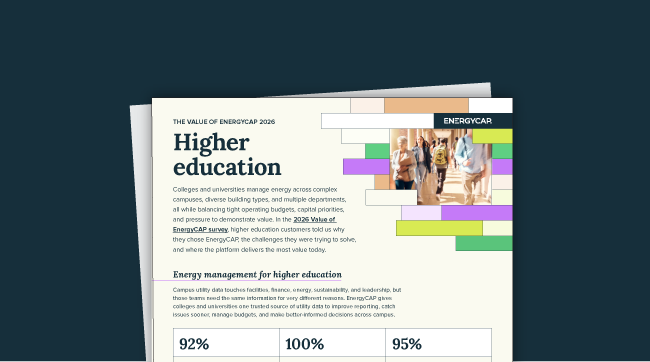
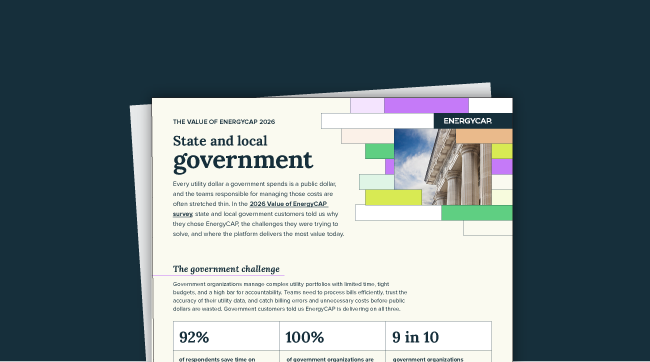
In a recent EnergyCAP customer survey, 92% of users reported saving time on front-end utility bill processing.
That’s significant. But there’s a catch. Finance departments distinguish between soft savings and hard savings. If automation saves an employee 30 hours a month but that employee remains on payroll, the organization hasn’t necessarily reduced its expenses.
The time has value, but it hasn’t yet translated into a measurable reduction in spending. And that’s why efficiency business cases based exclusively on labor savings often struggle to gain approval.
The problem isn’t that the labor savings are insignificant. It’s that they’re only the beginning of the story.

Here’s a question every facilities leader should consider: How much money is your organization spending today on problems nobody knows exist?
Perhaps an air handler is operating around the clock because its schedule reset after a power outage. Maybe a rooftop HVAC unit has developed a natural gas leak. Or an irrigation valve is stuck open, sending thousands of gallons of water down the drain.
These problems have something in common: They can continue for weeks or months without generating a maintenance request. The building might remain comfortable. Equipment might appear to operate normally. Nobody complains. But the utility meter keeps turning and the organization keeps paying.
Consider an equipment problem wasting $2,000 per month. If the problem continues for nine months before someone discovers it, the unnecessary expense reaches $18,000. Identify that same problem after two months, and the expense is $4,000. That’s $14,000 in avoided costs simply by identifying the problem sooner.
The repair itself hasn’t changed. What changed was the time it took to recognize that something was wrong. Now imagine that scenario playing out across hundreds of buildings and utility accounts. That’s where automated utility bill auditing, usage monitoring, and anomaly detection become valuable. Instead of waiting for someone to notice an unusually high bill, organizations can systematically compare actual consumption and costs against expected performance.
In the same EnergyCAP customer survey, 95% of customers reported that their utility data revealed operational issues that otherwise would have gone unnoticed. These problems weren’t created by the software, they were already happening. The difference is that someone finally had the information needed to identify them. Every month an operational problem goes undetected is another month your organization pays for it, and unlike labor savings, correcting unnecessary energy and water consumption can translate directly into lower utility expenses.
Then there’s the most overlooked, and potentially most valuable, part of the business case.
What happens when your facilities or energy management team gets those 30 hours back every month? If those hours simply disappear into more emails, meetings, and administrative work, you’ve improved productivity but may have little financial benefit to show for it. But what if you deliberately redirect that time toward reducing energy consumption and utility costs?
Consider what your team could accomplish:
These activities do something that data entry never will: they turn employee time into measurable financial results, and the opportunity can be substantial. Across energy conservation projects recorded by EnergyCAP customers over the past decade, reported savings average more than $250,000 per project. That doesn’t mean every project will deliver that return. But it demonstrates the financial potential of moving skilled employees away from repetitive tasks and toward higher-value energy management activities. The challenge is that most organizations never include this value in their original business case.
Why? Because the projects haven’t happened yet. Finance can easily calculate the cost of 30 hours of labor. It’s harder to assign a dollar value to an energy conservation opportunity that hasn’t been identified. But just because the opportunity hasn’t been discovered doesn’t mean it isn’t there. And one EnergyCAP customer provides a compelling example.
AFL, a global manufacturer of fiber optic and connectivity products, faced a familiar challenge. The AFL team was spending approximately 36 hours every month manually managing nearly 200 utility accounts. That’s more than a full workweek every month dedicated to processing utility information. After implementing EnergyCAP in December 2023, AFL automated data entry for nearly 98% of its accounts. That’s impressive on its own. But what happened next tells the bigger story.
First, AFL recovered valuable employee time. Automating utility data entry addressed approximately 432 hours of manual work annually. At an illustrative fully loaded labor rate of $50 per hour, that represents $21,600 in annual labor capacity. A respectable productivity improvement. But AFL didn’t stop there.
Next, the team uncovered costly operational problems. With better visibility into utility consumption and automated alerts, AFL identified issues that were quietly increasing operating expenses.
Among them:
Together, those problems represented approximately $14,000 in annual savings opportunities.
Then came the biggest opportunity: acting on the data. With more reliable information and time available for analysis, AFL pursued additional cost-saving opportunities. The results included:
Combined with the operational issues identified through utility monitoring, these initiatives represented approximately $304,000 in anticipated annual savings. Now compare that with the original labor calculation.
| Value category | Annual value |
|---|---|
| Labor capacity recovered (illustrative) | $21,600 |
| Operational issues identified | $14,000 |
| Energy conservation projects | $170,000 |
| Utility rate optimization | $120,000 |
| Total potential annual value | $325,600 |
The labor component represents only about 7% of the total potential annual value. In other words, a business case focused exclusively on hours saved would have overlooked more than 90% of the opportunity. That’s the difference between evaluating a tool as an administrative expense and understanding its potential as an operational investment.
Read the full AFL success storyIt’s important to recognize something about AFL’s success. Automating utility data collection didn’t magically reduce energy consumption. The software didn’t repair a leaking valve, adjust an HVAC schedule, or negotiate a better utility rate on its own.
People did those things. What changed was that the team had better information, greater visibility, and more time to act. This distinction matters because technology creates the opportunity for savings. People turn that opportunity into results.
Among facilities and energy management professionals, one challenge comes up repeatedly: These teams rarely have a shortage of worthwhile projects. They have a shortage of time.
There’s always another building to investigate, another utility account to review, another mechanical system to evaluate, and another capital project competing for attention. The question isn’t whether meaningful work exists. It’s whether the organization can free up enough capacity to get it done. That’s why redeployment must be part of the business case from the beginning.
Every energy and facilities professional should consider that utility bills contain far more information than the amount you owe each month. They tell a story about how your buildings operate. They can reveal equipment running when it shouldn’t, water consumption that doesn’t make sense, unexpected changes in demand, and opportunities to improve efficiency. But that story is difficult to uncover when the information is scattered across spreadsheets, utility portals, accounting systems, and filing cabinets. That’s where a utility management platform like EnergyCAP becomes valuable by centralizing your energy and utility data, capturing insights, saving you time, and helping control costs.

EnergyCAP centralizes your energy and utility data, captures insights, saves time, and helps control costs.
The next time you’re building a business case for energy or utility management software, don’t ignore labor savings. They’re real, they’re measurable, and they deserve a place in the conversation. But don’t stop there, because the biggest financial opportunities often have very little to do with the time spent entering utility bills. They come from finding problems sooner, correcting waste, optimizing utility costs, and giving skilled professionals the opportunity to focus on work that improves building performance.
How much value could your organization be overlooking?
The 2026 Value of EnergyCAP Report explores how more than 100 organizations are using utility data to uncover savings opportunities, improve operational efficiency, and measure the financial impact of their energy management programs.
Discover why the return on better utility management extends far beyond hours saved.
Explore the 2026 Value of EnergyCAP Report