Headquarters
EnergyCAP, LLC
360 Discovery Drive
Boalsburg, PA 16827
Denver, CO
Suite 500
5445 DTC Parkway
Greenwood Village, CO 80111
Dublin, Ireland
Unit F, The Digital Court, Rainsford Street,
Dublin 8, D08 R2YP, Ireland
Phone: 877.327.3702
Fax: 719.623.0577
Search “GHG reporting software” and the first ten results are the same ten platforms in different orders. They’re built for the global Fortune 500: supply-chain emissions, financed emissions, product-level carbon accounting. Useful tools for the organizations that need all of that.
For most hospitals, universities, school districts, government portfolios, and multi-site retailers, those platforms are overbuilt. If your Scope 1 and 2 emissions come almost entirely from utility bills, the right software isn’t a smaller version of Persefoni. It’s a different category of tool entirely.
This post explains the three categories of GHG reporting software and gives you three diagnostic questions to figure out which one actually fits. If you’re still deciding whether you need to report at all, start with our post on the wave of state-level disclosure laws—then come back here.
GHG reporting software is software that calculates, tracks, and reports an organization’s greenhouse gas emissions across Scope 1, 2, and where applicable Scope 3, in line with the GHG Protocol. It supports disclosure to frameworks including SB253, CSRD, SECR, ENERGY STAR® Portfolio Manager®, and CDP.
Here’s the problem with that definition: it describes several categories of tool that work very differently and fit very different buyers.
The urgency behind this question is real. According to EnergyCAP’s State of Utilities 2026 Report, 39% of organizations say improving billing accuracy and reducing rework is one of their top utility management goals for 2026. Put differently: nearly half of organizations don’t yet have the data infrastructure to support a credible GHG report. The category of tool you choose either solves that problem or assumes it’s already solved.
GHG reporting software is not one category. It’s at least three, and they’re not interchangeable.
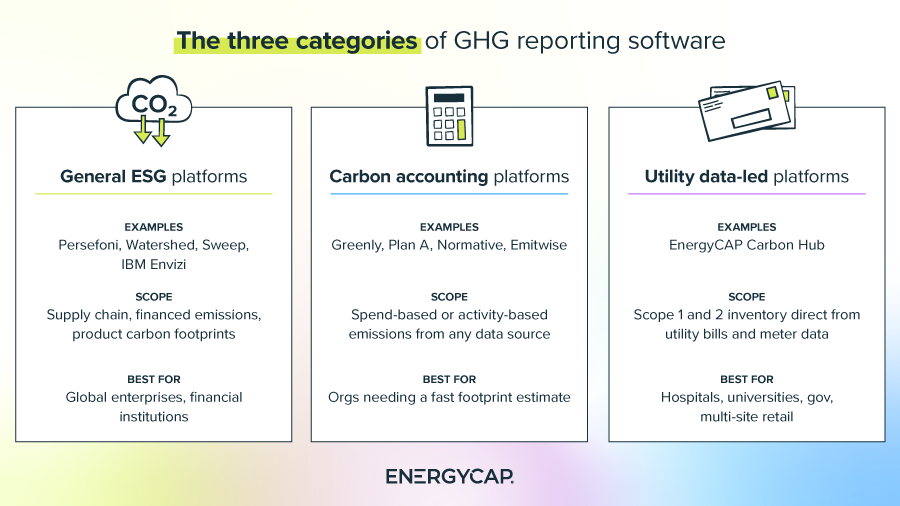
Platforms in this group—Persefoni, Watershed, Sweep, IBM Envizi, Microsoft Sustainability Manager, Salesforce Net Zero Cloud—are built for organizations with diverse emissions sources across the value chain: supply chain, financed emissions, product carbon footprints, procurement, and business travel.
Platforms like Greenly, Plan A, Normative, Emitwise, and Arbor calculate emissions from any activity-data source using spend-based or activity-based methods. They’re built to produce a footprint estimate quickly, even when centralized utility data isn’t available.
A smaller category: platforms that produce a Scope 1 and 2 GHG inventory directly from utility bills and meter data. The GHG calculation starts from the same source the data starts from. For how this data flow actually works, see our post on automating GHG data collection from utility bills.
Category isn’t a feature question. It’s a question about where your emissions data comes from, what share of your footprint it covers, and who needs to use the output. Three diagnostic questions:

70% of energy management teams have six or fewer people. Bandwidth—lack of time and staff—is a top-3 barrier for respondents across the board. Software fit is partly a team-size question. A small team can't afford an implementation that requires building a data layer from scratch before the GHG work can begin.
Every category of GHG software is only as good as the data underneath it. Regardless of which platform you use, an auditor reviewing your GHG report will look for four things:
The data layer is where this breaks down for most organizations. On EnergyCAP’s platform, 1 in 5 utility bills that arrive contains some kind of error: duplicate charges, estimated reads, mismatched account numbers. If 20% of your input data has errors, no amount of carbon accounting downstream produces a clean report.
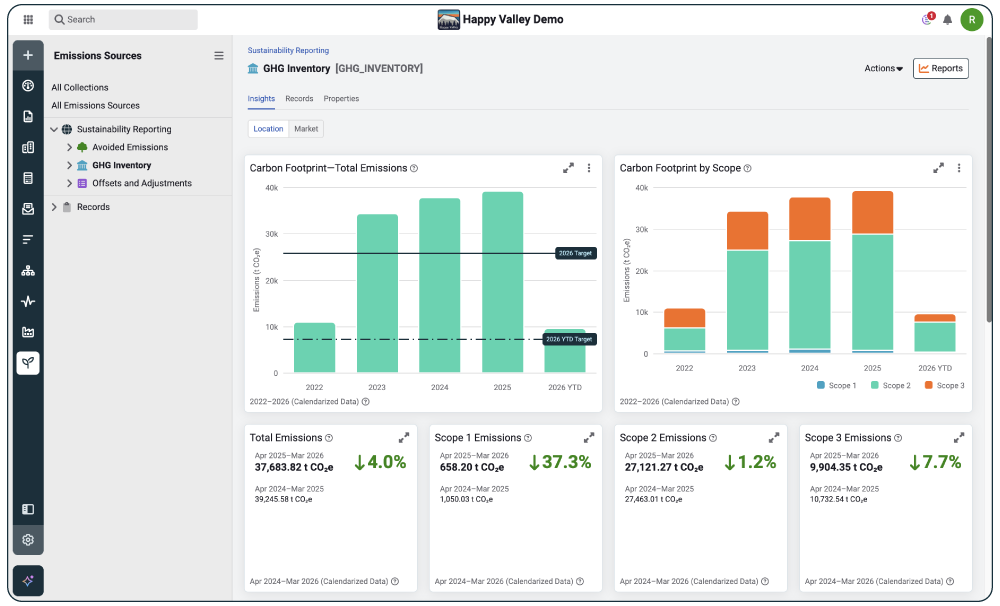
EnergyCAP Emissions converts utility bills into Scope 1, 2, and 3 emissions inventories using EPA, eGRID, IEA, and other standard factors; both location-based and market-based. The audit trail goes from the reported number back to the source bill, the meter read, and the calculation. Emissions also submits data directly to ENERGY STAR Portfolio Manager, with scores and certifications syncing back into EnergyCAP without double entry.
Carbon Hub fits well when:
A different category is the better fit when:
That’s an honest answer. Most GHG reporting software vendors won’t give it to you.
If Carbon Hub sounds like the right fit for your organization, the Carbon Hub page is the right next step. If you’re still working through the broader question of sustainability reporting for your facilities and finance teams, start with our sustainability reporting software post for the broader Facilities + Finance picture.
GHG reporting software calculates, tracks, and reports an organization’s greenhouse gas emissions across Scope 1, 2, and where applicable Scope 3, in line with the GHG Protocol. It supports disclosure to frameworks including SB253, CSRD, SECR, ENERGY STAR Portfolio Manager, and CDP. The term covers three distinct categories of tool with meaningfully different strengths—which this post explains.
The terms are often used interchangeably, but they emphasize different things. Carbon accounting platforms focus on calculating emissions from any activity-data source, often using spend-based or activity-based methods. GHG reporting software tends to emphasize the disclosure output itself; the report that goes to a regulator, auditor, or framework. Most platforms do both; the difference is where they start and what they’re optimized for.
Scope 1 covers direct emissions from sources you own or control: boilers, on-site fuel combustion, fleet vehicles. Scope 2 covers indirect emissions from purchased electricity, steam, heating, or cooling. Both are required under SB253 and most state-level disclosure frameworks. Scope 2 also requires dual reporting: a location-based calculation (using the emissions intensity of your local grid) and a market-based calculation (using renewable energy certificates or supplier rates, if applicable).
Not necessarily. If your utility platform produces a Scope 1 and 2 inventory with a full audit trail—source-document linkage, calculation transparency, version control, and dual-reporting for Scope 2—that may be your GHG reporting software. The distinction matters most for organizations with significant Scope 3 emissions to model beyond utility data.
Traceability from the reported number back to the source: the bill, the meter read, the calculation. It includes version control on calculation factors, dual-reporting for Scope 2 (location-based and market-based), and source-document linkage. The auditor’s bar, not the marketer’s.
Carbon Hub produces a Scope 1 and 2 GHG inventory with a full audit trail, which covers the utility-data portion of CSRD disclosure requirements. For organizations with significant Scope 3 exposure or broader CSRD obligations beyond Scope 1 and 2, Carbon Hub works alongside broader ESG frameworks. If CSRD or SECR readiness is your primary driver, the right conversation starts with understanding what share of your total footprint is utility-derived.