Headquarters
EnergyCAP, LLC
360 Discovery Drive
Boalsburg, PA 16827
Denver, CO
Suite 500
5445 DTC Parkway
Greenwood Village, CO 80111
Dublin, Ireland
Unit F, The Digital Court, Rainsford Street,
Dublin 8, D08 R2YP, Ireland
Phone: 877.327.3702
Fax: 719.623.0577
The AI conversation in energy management is moving faster than the data is ready for. That gap is worth talking about.
Not because AI isn’t useful. It is, when placed in the right hands, powered by the right data, and built for the right problem. The issue is that most AI tools being pitched to energy and facilities teams right now were not built for utility data. They were built for cleaner problems. And when you put a general-purpose AI tool on top of utility billing data, you get general-purpose mistakes delivered with confidence.
Most datasets that AI tools are trained on share a common property: they are structured, consistent, and relatively clean. Utility billing data is none of those things.
Bills arrive late, or not at all. Estimates get posted and never corrected when actual reads come in. Costs land in the wrong accounts. One organization might manage hundreds of meters across dozens of providers, each formatting data differently, each running on their own billing cycle. The information that represents your actual energy spend is fragmented, inconsistent, and riddled with exceptions.
None of this is unusual. It is the normal operating condition of utility data management. But it means that an AI tool built on assumptions of clean, structured input is starting from the wrong place.
Generic AI does not know what it does not know. That is the core problem.
Ask a general-purpose AI tool to extract a utility bill, and it will produce an answer. It will fill gaps where data is missing. It will assign charge types based on patterns it has seen elsewhere. It will deliver a clean-looking output with no indication of where it guessed, where it misread, or what it left out.
EnergyCAP data shows 1 in 5 utility bills contains an error before any AI gets involved. Add an extraction tool that is not built to validate against expected bill behavior, and those errors compound silently. Duplicated charges. Misread demand figures. Missed rate riders. The output looks clean. The data is not.
Everything built on that data, including benchmarking, savings calculations, carbon reporting, project justification, inherits the error. By the time someone in finance questions a number, it has already been presented to leadership, submitted for compliance, or used to justify a capital decision.
The problem is not that AI makes mistakes. It is that generic AI does not flag them.
Utility data quality problems follow predictable patterns. Each one creates a different risk when AI is applied to messy billing data.
Missing bills, months, or meters are invisible to tools that are not actively looking for them. Missing data is often treated as zero or excluded from calculations, which distorts every aggregate that follows.
Double-posted bills, duplicate accounts, and phantom usage teach AI the wrong patterns. A model trained on duplicated data learns to expect usage levels that do not exist.
Uninvestigated anomalies become part of the baseline. Generic AI normalizes them instead of surfacing them because it cannot distinguish an unexplained spike from a legitimate one.
Charges assigned to the wrong meter, account, or cost center flow through to downstream reporting without correction. Generic AI does not understand your allocation structure.
Mixed units, wrong denominators, and conversion mistakes produce numbers that look plausible but are still wrong. These errors are easy to miss unless the system understands the data context.
None of these are edge cases. They are the routine reality of utility data management at scale. An AI tool that cannot handle them is not ready for this problem.
A question that surfaces regularly: why not just use ChatGPT or a spreadsheet to pull data from utility bills? You can. But extraction is not the hard part. Verification is.
EnergyCAP Bill Capture does not just extract bill data. It validates it. Every bill is checked against expected behavior, flagging anomalies, catching errors, and building a complete audit trail before the data enters your system. The output is not extracted data. It is verified data.
That distinction matters because everything downstream runs on it. Benchmarking. Savings calculations. Carbon reporting. M&V. The credibility of every number you produce is only as strong as the foundation it is built on.

EnergyCAP Watts AI is not a general-purpose AI tool adapted for energy management. It is an AI tool built on 45+ years of audited, validated, financial-grade utility data, a foundation that makes the difference between an answer that looks right and one that actually is.
Watts AI runs within your data. Not a shared model trained on the open web. Not pattern matching against datasets from unrelated industries. Your accounts, your bills, your sites are combined with decades of domain-specific training that no competitor can replicate.

EnergyCAP Watts AI—built on 45+ years of audited, financial-grade utility data that runs within your organization's own accounts, bills, and sites.
That foundation is what makes Watts AI outputs defensible. When a number comes out of Watts, you can walk it backward through the calculation. You can show the data source, the validation step, and the logic. You can put it in front of a finance or a compliance auditor and stand behind it.
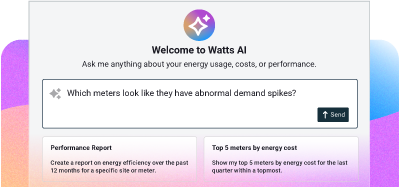
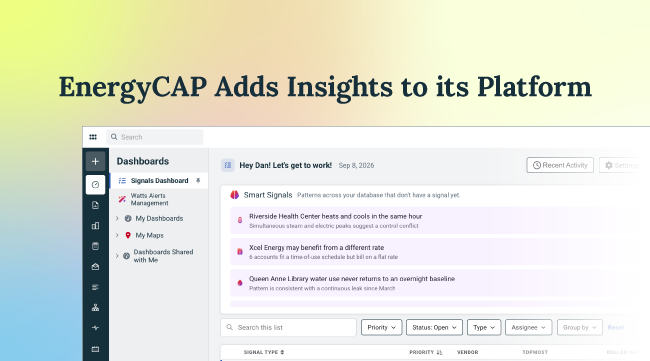
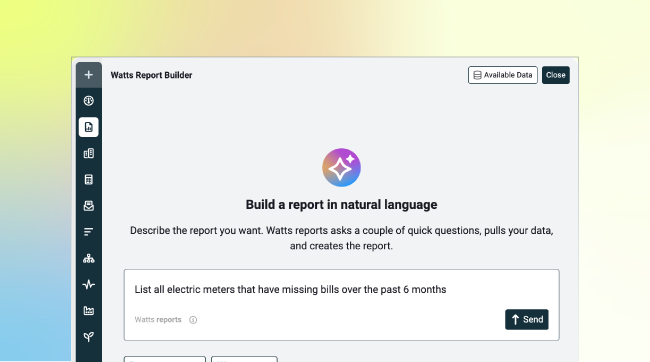
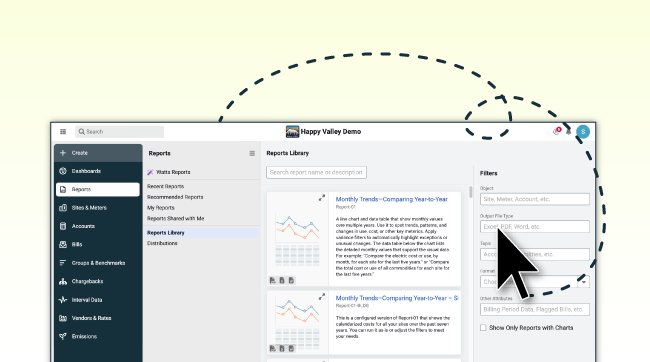
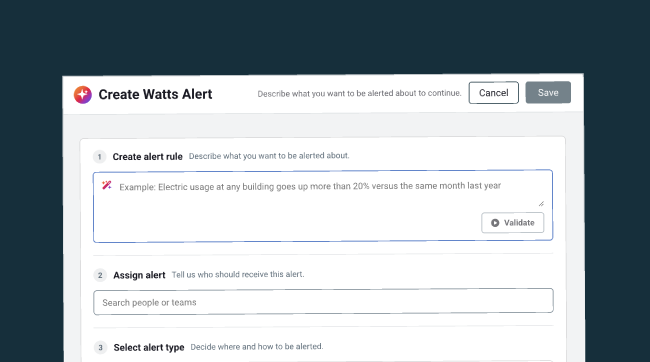
Machine learning has been part of how EnergyCAP works since long before anyone called it AI, forecasting expected bill behavior, flagging anomalies before they reach your utility bill, catching errors that manual review misses. That foundation is what Watts AI is built on. Watts Chat is where that starts, a way to ask questions about your data and get fast, accurate answers, grounded in the same audited, validated foundation EnergyCAP has built over decades. No hunting through reports. No exporting to a generic tool that doesn’t know your rate structures. The answers come from your data, with the context to make them actually useful.
The question before adopting any AI tool is not what it can do in a demo. It is whether it was built for the problem you actually have.