




Higher education institutions are being asked to do more with less. Facilities teams are managing complex campuses and aging infrastructure, finance teams are watching operating budgets closel...



Headquarters
EnergyCAP, LLC
360 Discovery Drive
Boalsburg, PA 16827
Denver, CO
Suite 500
5445 DTC Parkway
Greenwood Village, CO 80111
Dublin, Ireland
Unit F, The Digital Court, Rainsford Street,
Dublin 8, D08 R2YP, Ireland
Phone: 877.327.3702
Fax: 719.623.0577
The question isn’t whether to use AI for energy management. Most organizations are already exploring it. The real question is whether the data underneath those AI tools is clean enough to trust the answers they produce.
It’s a gap that doesn’t get enough attention and one that Tom Diliberti, EnergyCAP’s Senior Manager of Energy and Utility Solutions, explored in a recent webinar for the Association of Energy Engineers.
Watch the full webinar recordingHere’s a deeper look at the framework.
Before getting to AI, it helps to understand the financial environment energy managers are working in right now. U.S. utility rates are projected to increase 12–25% through 2027, and the reasons vary by region:

EnergyCAP projections based on blended estimate (electricity and natural gas), EIA forecast, and analysis reports.
Across a large portfolio, those increases compound fast. An organization managing 500 meters at $2M in annual utility spend is looking at a potential $300K–500K increase. That’s the backdrop for every AI, compliance, and efficiency conversation happening in 2026. Curious how data center demand factors into that outlook? Read more on data centers and rising rates, or run the numbers yourself with EnergyCAP’s utility bill increase calculator.
The regulatory landscape for buildings and energy data breaks into four categories, each building on the one before:
Benchmarking: establishes your baseline EUI. Low barrier to entry, but creates the data foundation everything else depends on.
Building performance standards (BPS): mandates EUI targets or emissions caps. Buildings must cut energy use to comply, and penalties for noncompliance can be steep.
Audit and recommissioning: requires HVAC, lighting, and controls to be professionally assessed and upgraded where needed. Growing in cities like New York and Seattle.
Climate disclosure: requires standardized Scope 1, 2, and eventually 3 emissions reporting to investors, lenders, and regulators.
Several 2026 deadlines are already on the books. California SB 253 now requires first Scope 1 and 2 emissions disclosures by November 10, 2026, for organizations with more than $1 billion in revenue. CARB pushed the original August 10 deadline by three months on June 24 to give reporting companies more time as the final regulations work through OAL approval. The November 10 date is still subject to that process—treat it as the working target, not a settled deadline.
New York’s S9072A closely mirrors SB 253, with first Scope 1 and 2 reports due July 1, 2027, and Scope 3 reports due December 31, 2027. Milwaukee, Detroit, Indianapolis, and several other cities are also seeing first-time benchmarking mandates go live this year.
Energy Star is funded through FY2026, but FY2027 funding has not been finalized. The program transitioned from EPA to DOE management in March 2026, and staffing levels at the EPA were significantly reduced through buyouts and restructuring. If your organization actively uses the Energy Star platform, the short-term advice is simple: keep your data current and back it up.
The common thread across all of these mandates? Accurate, complete, auditable utility data. Which brings the AI problem into sharp focus.
AI tools are widely available and genuinely promising for energy management. But the data most organizations are trying to run AI on isn’t ready for it. The numbers are striking:
Manual data entry is the most common point of failure. Estimated bills get posted and never corrected. Meters span multiple providers in different formats. Units of measure are inconsistent and not uncommon, for example, for a water utility to report usage in a unit that doesn’t match the bill, or to list no unit at all.
These problems don’t disappear when you introduce AI. They get reported faster, at greater scale, and with more confidence than before.
Five categories surface consistently: gaps, duplicates, outliers, misallocated costs, and unit errors. Each creates a different failure mode when AI is applied without correction. For a detailed breakdown of what each looks like in practice, and why generic AI tools can’t handle them, see why generic AI gets utility data wrong.
As Tom put it: “Flawed data and powerful AI give you faster and more confident mistakes.” AI doesn’t flag what it doesn’t know is wrong. If your baseline includes estimated reads that were never corrected, your AI-generated savings forecast will look precise and be off.
A pre-deployment checklist to run before piloting any AI tool on your utility data:
When evaluating AI tools or vendors, these are the right questions to push on:
That last question matters most. AI outputs should be treated as drafts: starting points for analysis, not final answers. Anything going to leadership, finance, or an auditor requires human review.
When the data is right, AI has genuine value in energy management. Five areas where it makes energy teams faster and more effective:
The right model isn’t AI alone. AI handles volume and pattern recognition; human judgment validates, interprets, and defends the outputs. As Tom noted: “Confident-sounding wrong answers are worse than no answers.”
The data quality challenge outlined above is exactly what EnergyCAP Watts AI is designed to address, from both sides.
EnergyCAP’s platform has been built around clean, structured utility data for decades. Automated bill auditing, validation workflows, and anomaly detection have been working behind the scenes: catching billing errors before payment, flagging estimated reads, and surfacing outliers before they compound. That foundation is what makes AI useful rather than risky.
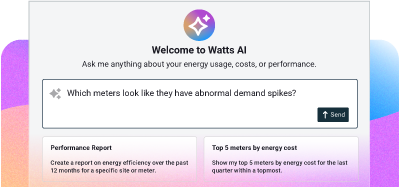
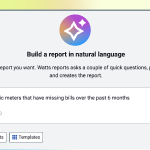
Watts Chat, EnergyCAP’s first Watts-powered feature, builds directly on that foundation. Energy, finance, and facilities teams can explore utility data conversationally: ask a plain-language question, get a clear answer with an explanation, and follow up to drill deeper. No exports. No pivot tables. No waiting for a manual report pull.
Because Watts Chat runs entirely within EnergyCAP’s secure environment, your data stays yours. It’s not shared with an external model, not used to train a general-purpose AI. It’s purpose-built for the specific context that drives utility spend: your bills, your meters, your vendor accounts, your operational history, backed by 45 years of energy and utility expertise.
Get the data right first. Let AI move you faster. Verify what it tells you. The cycle of preparing, analyzing, validating the data is what turns AI from a liability into a real advantage.
2026 is one of the more demanding years in recent memory for energy managers: rates rising, compliance deadlines active, and an industry-wide push toward AI that hasn’t fully reckoned with what AI actually requires.
The path through it is straightforward, even if it takes work: get the data right first, then let AI move you faster. EnergyCAP Watts AI is built to do exactly that.

AI-ready utility data is complete, consistent, and verified: free of the gaps, duplicates, unit errors, and misallocated costs that cause AI models to produce inaccurate results. At minimum, that means complete bill history for at least 12 months (24–36 months preferred), validated units of measure, and a clean account inventory with no unresolved duplicates or missing meters.
Utility data is unusually complex: bills arrive from dozens of vendors in different formats, estimated reads get posted and never corrected, and meters span multiple accounts and cost centers. AI amplifies whatever is in the data. Clean data produces useful insights; flawed data produces confident-sounding mistakes at scale.
EnergyCAP centralizes utility data from any source, validates it through automated bill auditing and anomaly detection, and gives energy teams the tools to identify and resolve data quality issues across their entire portfolio. Watts Chat lets teams then explore that verified data conversationally, turning months of bill history into clear, auditable answers in seconds, without exporting to spreadsheets or waiting for a manual report.