





Higher education institutions are being asked to do more with less. Facilities teams are managing complex campuses and aging infrastructure, finance teams are watching operating budgets closel...



Headquarters
EnergyCAP, LLC
360 Discovery Drive
Boalsburg, PA 16827
Denver, CO
Suite 500
5445 DTC Parkway
Greenwood Village, CO 80111
Dublin, Ireland
Unit F, The Digital Court, Rainsford Street,
Dublin 8, D08 R2YP, Ireland
Phone: 877.327.3702
Fax: 719.623.0577
Search ‘utility billing software for municipalities’ and nearly every result is built to do one thing: bill residents for the water and sewer a town provides. That is a real category, but it is not the one most government finance and energy teams lose sleep over.
The harder problem is the other side of the ledger: the utility bills your government receives, spread across courthouses, fire stations, parks, and treatment plants. Which usually includes dozens of vendors and hundreds of accounts. Two-thirds of government organizations saw those bills rise last year. Half are not fully confident their utility budget is even accurate.
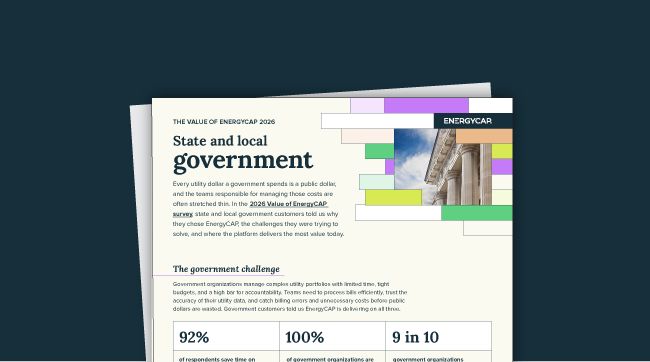
This guide is about that problem: controlling what you spend on utilities, managing the bills you receive, and producing the defensible numbers a public institution requires. For what the 2026 data reveals for government, the trends below are a useful starting point.
The term creates real confusion. Utility billing software, as most search results use it, refers to CIS (customer information system) platforms: tools a town uses to generate and send resident utility bills. Think municipal water billing or sewer service.
Utility cost management software is different. It handles the bills your government receives and pays like electricity, natural gas, water, and waste accounts across your own portfolio of buildings and facilities. Different job, different buyer, different vendors.
EnergyCAP® sits squarely in the second category. If you are looking for software to bill your residents, this is not that guide. If you are trying to control what your government spends on utilities and defend every number to an auditor, a council member, or the public. The blog provides clarity.
Government teams face a specific set of constraints that commercial organizations do not.
Rising costs are the immediate pressure. According to EnergyCAP’s State of Utilities 2026 report, 66% of government organizations saw utility budgets increase in the past year, and 61% say controlling or reducing total utility spend is their top goal for 2026. That intent runs into a structural problem: government budget cycles run 12–18 months. By the time a budget request is approved, the rate environment it was built around has already shifted.
Aging buildings compound the problem. Older facilities consume more, fail more often, and generate billing anomalies that are harder to explain. Without a systematic way to track consumption trends, the anomalies surface on the bill, not in advance.
And then there is the staffing reality. One in five government organizations relies on a single person for every aspect of energy management. Thirty-nine percent cite staff bandwidth as their top operational blocker. This is the highest rate of any sector. When one person is responsible for capturing bills, auditing them, reporting to finance, and responding to council requests, something has to give. Usually it’s the audit.
The software has to carry the load a lean team cannot.

A buyer’s guide is only useful if it covers what actually matters. For a local government team, these are the capabilities worth evaluating:

Commercial software buyers ask about features, integrations, and price. Government buyers ask about all of that and several things most vendor guides never mention.
Procurement and cooperative purchasing. Government organizations often cannot buy software through a standard sales process. Schedule contracts and cooperative purchasing agreements, where one agency’s approved contract is ‘piggybacked’ by another, are the most common path. These vehicles allow a government to skip a formal RFP while still satisfying procurement requirements. Ask early which vehicles a vendor participates in.
Data sovereignty and security. States are increasingly vetting software vendors for foreign ownership and data residency. Ask directly: where is data stored, who owns it, and what security certifications does the vendor hold? Expect an IT Director to ask the same questions late in the process and come prepared with SOC 2 documentation.
Audit defensibility. A government’s energy data needs to hold up to external auditors, not just internal review. ‘Audit-ready’ is not a marketing phrase here. It is a functional requirement. Ask whether the platform maintains a complete, immutable audit trail.
Peer government references. A government buyer wants to talk to another government buyer, not a commercial reference. Ask for references from organizations of similar size and structure before you commit to a demo.
Vendor stability. Government procurement cycles are long. The vendor you evaluate in Q1 may not complete a contract until Q4 of the following fiscal year. Long-term vendor stability including financial health, product trajectory, and support continuity matters more here than in most commercial evaluations.
Not every team needs to run the software themselves. For organizations with severe staff constraints, managed bill processing services, where a vendor retrieves, validates, and processes bills on your behalf, can eliminate the operational bottleneck without adding headcount.
EnergyCAP’s Bill Operations suite covers the full spectrum: Bill Capture (automated retrieval from vendor portals), Bill Retrieval, Bill Review, and Bill Pay. Teams can run the platform themselves, use managed services, or combine both depending on capacity and preference.
The question to ask: does your team have the bandwidth to manage bill intake reliably, or does that function need to be outsourced? The answer shapes which procurement model fits.
EnergyCAP’s utility bill and energy management software has served state and local government for more than four decades. Miami-Dade County, Riverside County, the State of Colorado, and hundreds of comparable organizations use EnergyCAP to manage the utility costs their governments pay and track, audit, and report them with the rigor a public institution requires.
The Coral Gables, FL case is a useful illustration. After deploying EnergyCAP, the City achieved 20% reductions in electricity use, 22% reductions in water use, and 20% reductions in GHG emissions. Outcomes that required accurate, centralized data before any reduction strategy was possible.
Across all EnergyCAP customers, most report utility cost savings of 10% or more over the prior year. For a government with a $2 million annual utility spend, that is $200,000 in recovered budget (year over year).
The platform produces financial-grade utility data: fully auditable, complete audit trail, defensible to finance, to auditors, and to elected leadership. That is the standard a public institution requires, and it is what EnergyCAP is built to deliver.

If your organization is operating on spreadsheets, managing dozens of vendor portals manually, or unsure whether your utility budget is accurate, the place to start is your data.
EnergyCAP’s State of Utilities 2026 report includes a government-specific breakdown of where public-sector organizations stand today: cost trends, staffing constraints, top goals, and the gaps between where teams are and where they need to be. It is a useful benchmark before any evaluation conversation.
For a closer look at EnergyCAP’s approach for state and local government, the government energy management page covers the platform’s capabilities and peer references in detail.
Explore EnergyCAP for government
Utility cost management software centralizes the utility bills a government receives and pays across its own facilities: courthouses, fire stations, transit hubs, parks, and more. It audits those bills for errors before payment, tracks spend against budget across the full portfolio, and produces audit-ready reporting for finance, auditors, and elected leadership. It is not software for billing residents, that is a different category entirely.
No. Utility billing software, often called a CIS, or customer information system is what a municipality uses to generate and send bills to residents for water, sewer, or electric service it provides. Utility cost management handles the bills the government itself receives and pays across its own facilities. Different job, different buyer, different tools.
An ERP records what was paid. It does not audit utility bills for errors before payment, normalize consumption data across accounts, or benchmark facilities against prior periods. Utility cost management software operates as a layer upstream of the ERP: it captures, validates, and enriches bill data so that what enters the general ledger is clean, complete, and defensible. The two systems are designed to work together, not to replace each other.
Public-sector data has a higher bar than commercial data. A utility cost management platform built for government maintains a complete, immutable audit trail behind every figure. When an auditor, council member, or public records request arrives, the underlying data is traceable, documented, and ready. Billing accuracy is also a public accountability issue: 46% of government respondents prioritize improving billing accuracy and reducing rework, compared to 31% across all industries.
Yes, and for most government teams, that is exactly the use case the platform is built for. Automation handles bill retrieval, anomaly detection, and routine reporting. One in five government organizations relies on a single person for every aspect of energy management. The software does the work that a lean team cannot do by hand, so the person running it can focus on analysis and reporting instead of data entry and manual review.
Schedule contracts and cooperative purchasing agreements are the most common path. A cooperative purchasing agreement allows one government entity to piggyback on a contract already approved by another, satisfying procurement requirements without a full RFP process. Ask any vendor early which contract vehicles they participate in, and confirm whether your state or county has an existing agreement you can use.